Cleaning your aircon filter at home in Singapore is usually free if you DIY, but in 2026, getting a professional to do a full general servicing (including filter cleaning) typically costs about $22–$65 per unit, with most households paying around $30–$50 per unit depending on unit type and number of units serviced at once. For deeper work like chemical wash or overhaul, prices increase to around $80–$180 per unit, while a standard residential gas top-up usually starts from about $80 per job in 2026.
This cluster guide focuses on How to Clean Aircon Filter at Home Cost Guide: Singapore Prices 2026 and links back to Homejourney’s main aircon servicing and home maintenance pillar content, so you can decide when DIY is enough and when a verified technician is the safer choice. In Singapore’s hot, humid climate, a clean filter is not just about comfort – it affects your electricity bill, indoor air quality, and even mould risks in HDB and condo units.
How to clean an aircon filter at home in Singapore (step-by-step)
If your aircon is a typical wall-mounted split unit in an HDB flat or condo, you can usually clean the filter yourself in under 20 minutes. Based on day-to-day experience in estates like Punggol, Sengkang, and Woodlands where aircon runs nightly, most residents should do a basic filter wash every 3–4 weeks in heavy-use rooms to keep cooling strong and odours away.
Quick checklist: what you need
To safely clean your aircon filter at home, prepare:
- Dry cloth or microfiber cloth
- Soft brush or old toothbrush
- Mild dish soap (non-corrosive)
- A basin or bathroom floor area with floor trap (common in HDB bathrooms)
- Step stool (especially for higher-mounted units in high-ceiling condos or maisonettes)
Always switch off the aircon at the remote and turn off the main power at the wall or isolator switch before you start. In some older HDB blocks and many condos, the isolator switch is next to the indoor unit or along the corridor wall.
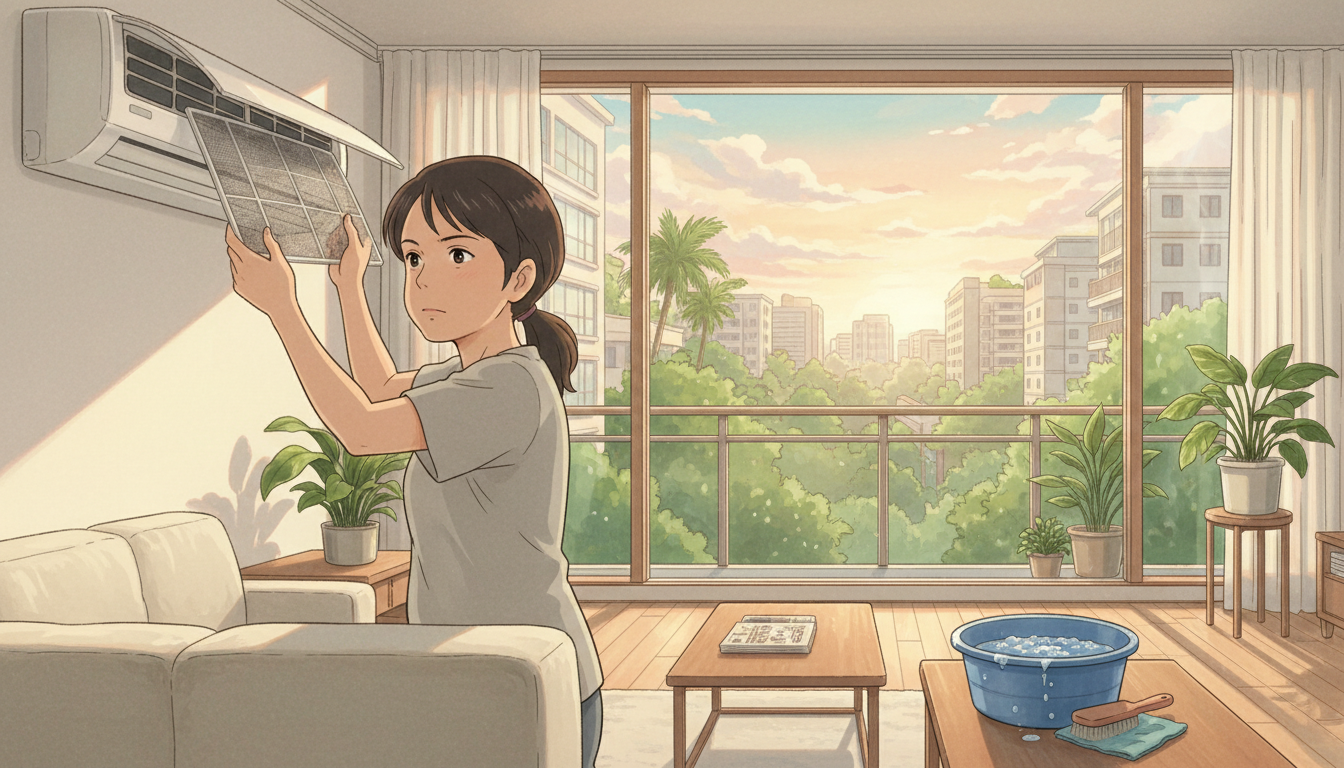
Step-by-step: DIY aircon filter wash
- Turn off power
Make sure the unit is off at both the remote and the power switch. This reduces risk of electrical shock and prevents the fan from turning while you’re working. - Open the front cover
Gently lift the front panel of the indoor unit. Most HDB and condo split units have clips on both sides; you’ll feel it click into an open position. - Remove the filters
Slide out the plastic mesh filters carefully. Some units also have an additional fine mesh or PM2.5 filter layer – note how it’s positioned so you can put it back correctly. - Dry dust removal
Take the filters to a bathroom or service yard. Tap gently to shake off loose dust. Avoid doing this in the living room or bedroom as dust can spread onto furniture. - Rinse with water
Use lukewarm running water to wash the filters from the clean side to the dirty side. This pushes dust out instead of deeper into the mesh. - Add mild soap if oily
If you cook frequently (common in 3-room and 4-room HDB flats where the kitchen is close to the living area), light oil can stick to filters. Add a few drops of mild dish soap, gently rub with your fingers or a soft brush, then rinse thoroughly. - Check for damage
Look for tears or warping in the plastic frame. Damaged filters should be replaced; continuing to use them can allow dust to clog the coil. - Air dry completely
Let the filters dry fully, ideally 1–2 hours in a shaded, well-ventilated area. Avoid direct strong sun, which can warp plastic over time. - Reinstall the filters
Slide the dry filters back into the unit, following the original orientation. Make sure they sit flat and latch properly. - Wipe the exterior
Use a slightly damp cloth to wipe the front panel and visible surfaces. This removes dust that can blow into the room when the unit restarts.
Once everything is back in place, turn on the power and run the aircon. You should notice slightly stronger airflow and, in many cases, reduced musty smell.
How often should you clean your aircon filter in Singapore?
Because of Singapore’s humidity and year-round aircon usage, filters clog faster than in temperate countries. From experience living in estates like Tampines and Jurong where families run their bedroom aircon almost every night, a simple rule works well:
- Every 3–4 weeks: Bedrooms used nightly
- Every 1–2 months: Living rooms used a few evenings a week
- More often if you have pets, smokers at home, or allergy sufferers
For professional servicing, Homejourney recommends a general servicing schedule of about every 3 months for residential units, which aligns with common industry advice in Singapore’s climate. DIY filter wash is a supplement, not a full substitute, for periodic professional checks.
DIY vs professional: 2026 aircon servicing costs in Singapore
Doing your own aircon filter wash keeps your basic maintenance cost at $0, beyond your time and water. But for deeper cleaning and system health, it helps to know current 2026 prices if you book a verified technician through Homejourney’s aircon services section Aircon Services .
Key service types and typical 2026 prices
Based on aggregated 2026 market data from Singapore providers and Homejourney’s own cost guides:
- General Servicing (includes filter cleaning)
• Typical 2026 range: about $22–$65 per unit
• Many residential providers, especially in heartland areas, offer around $25–$50 per unit, with lower per-unit rates if you service 3–4 units in one visit.
• Includes: filter cleaning, basic coil brushing, drainage check, simple function test, and visual inspection of gas pressure. - Chemical Wash
• Non-dismantle chemical wash: roughly $80–$150 per unit in 2026.
• Suitable when there is mild to moderate mould, bad odour, or visible slime on the coil but no major blockage. - Chemical Overhaul
• Full dismantle of indoor unit with deep cleaning: about $150–$320 per unit depending on severity and unit type.
• Typically for long-neglected systems, severe mould, or units not cooling even after general servicing. - Gas Top-Up
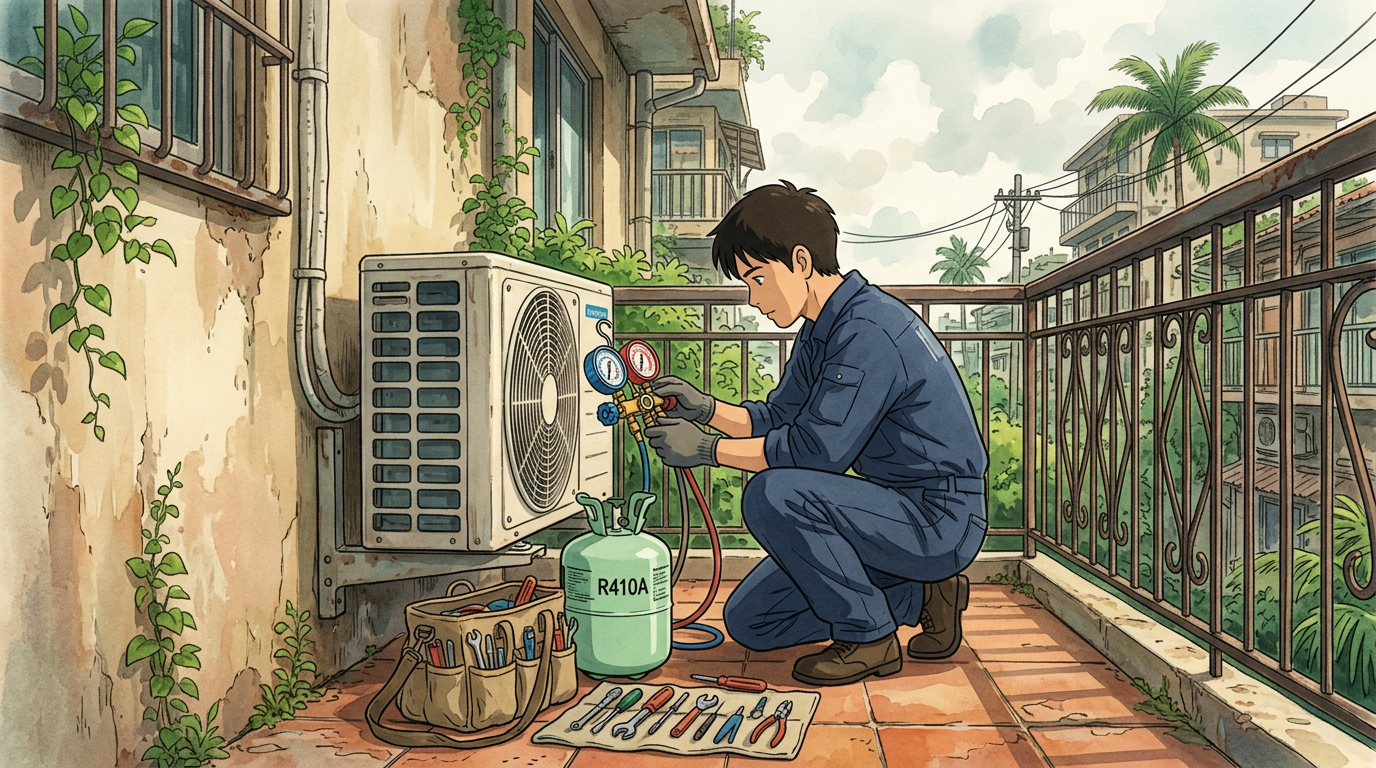
• For residential split units with no major leak: around $80–$160 depending on refrigerant and amount.
• Usually priced per job, not per filter, and only needed if gas level is low.
Homejourney’s own Aircon General Servicing Singapore Cost Guide: 2026 Prices shows typical one-time general servicing at about $50–$65 for 1 unit, dropping to around $95–$120 for 4 units, with quarterly contracts working out cheaper per visit. This is consistent with broader market ranges reported by independent cost guides.
When is DIY filter cleaning enough – and when is it not?
A quick DIY aircon filter wash is usually enough if the unit is otherwise healthy. But in HDB corridors and older condo blocks, it’s common to see units dripping water or blowing musty air – signs you need more than just a clean aircon filter.
DIY is usually enough if:
- Cooling is strong and the room reaches set temperature normally.
- No water is leaking from the indoor unit.
- No persistent mouldy or sour smell after cleaning the filter.
- The unit is relatively new (under 3–5 years) and has been serviced regularly.
Call a professional (general servicing or more) if:
- Aircon not cold even after filter wash – could be dirty coil, blower, or low gas.
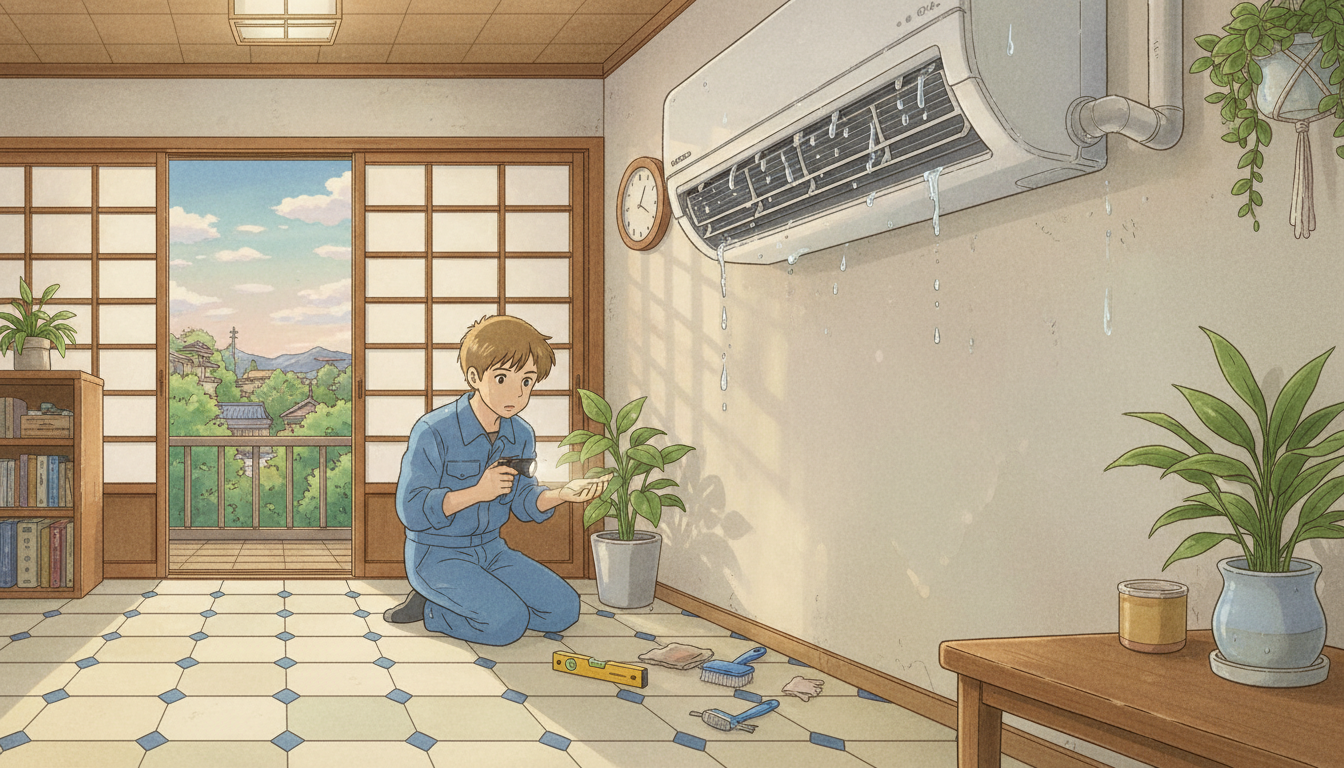
- Water leaking from the indoor unit – likely a choked drain line.
- Bad smell persists – mould on coil or blower, not just on filter.
- Unusual noises like rattling or whistling – loose parts or fan issues.
- Frequent tripping of the circuit breaker – possible electrical or compressor problem.
DIY cleaning only covers the filter mesh and light surface dust. It does not replace thorough internal cleaning, drainage flushing, or gas checks. For safety, avoid opening the indoor unit beyond the filter cover unless you are trained.
Singapore-specific safety and regulations to know
When you move beyond simple filter cleaning, Singapore regulations and building rules start to matter – especially in HDB flats, private condos, and landed homes.
HDB flats
For HDB owners and tenants:
- Basic DIY cleaning (like filter washing) is allowed as it does not change the structure or external façade.
- Any aircon installation or major alteration must follow HDB guidelines on installation methods and load.[HDB]
- Outdoor condenser servicing in high floors should only be done by trained technicians with safe access equipment.
Condo MCST rules
In condominiums, the Management Corporation Strata Title (MCST) may have rules about:
- Servicing time windows (e.g., no noisy works after 6pm or on Sundays).
- Contractor registration at the guardhouse and display of visitor passes.
- Use of service lifts instead of passenger lifts for equipment.
Before booking external works like chemical wash or gas top-up, check your condo’s house rules or speak to the management office, particularly in developments listed in Homejourney’s projects directory Projects Directory . This avoids conflicts and rejected contractor entries.
Licensed contractors and safety
For anything beyond filter cleaning, choose technicians who meet local requirements:
- BCA-registered firms for mechanical and air-conditioning works where applicable (Building and Construction Authority).
- Proper training in handling refrigerants (especially R32, which is mildly flammable) and electrical safety.
- Work-at-height safety gear for servicing outdoor units on higher floors.
Homejourney’s verified aircon providers are screened for proper experience, licensing where required, and track record, to support a safe environment for users.
Realistic DIY vs professional cost comparison (2026)
For a typical 4-room HDB flat with 3 units (2 bedrooms + living room) in 2026, here’s a practical way to think about DIY vs professional costs, based on Homejourney cost data and common market ranges.
Scenario A: DIY filter cleaning only
You clean all 3 filters monthly:
- Out-of-pocket cost: $0 (excluding water and your time).
- Time: about 15–20 minutes per unit, so roughly 1 hour per month.
- Risks: Coil and drain line still accumulate dirt; may face water leaking or reduced cooling over time.
Scenario B: DIY + quarterly general servicing
You clean filters monthly and book a technician once every 3–4 months.
- General servicing for 3 units: about $85–$100 per visit in 2026 based on Homejourney’s guide.
- 4 visits a year (quarterly): about $280–$340 per year.
- Benefit: Technician clears drainage, checks gas pressure, brushes coil and blower, and spots issues early.
Scenario C: Neglected units needing chemical work
If filters are rarely cleaned and no servicing is done for years, it is common in older estates and rentals to end up needing:
- Chemical wash for moderate mould: about $80–$150 per unit.
- Chemical overhaul for severe neglect: about $150–$320 per unit.
For 3 badly neglected units, this can easily exceed $450–$600 in one visit, not counting any gas top-up.
In practice, many Singaporean households find Scenario B (DIY filter wash + periodic professional servicing) gives the best balance of cost control, comfort, and safety.
How Homejourney keeps aircon servicing safe and transparent
Homejourney is built around user safety, verified providers, and transparent pricing for Singapore homes. For aircon servicing, this matters because most owners cannot easily verify the quality of internal work, and there have been cases of overcharging or unnecessary upselling in the market.
Key Homejourney features for aircon services
- Verified providers
All listed aircon technicians and companies go through checks on track record, business registration, and user feedback before being available for booking on Homejourney’s aircon services page Aircon Services . - Transparent pricing
Typical 2026 pricing ranges (e.g., general servicing around $22–$65 per unit, chemical wash from $80–$150 per unit) are clearly shown, with no hidden charges for basic on-site assessment. - Real reviews from Singapore homeowners
Ratings and reviews reflect actual jobs completed in local estates – from HDB blocks in Woodlands to condos in Paya Lebar and landed homes in Serangoon – so you see how providers perform in real conditions. - Easy booking and fast response
Same-day or urgent bookings are available for problems like sudden water leaks or aircon not cooling, which is crucial during hot spells and exam periods for families. - Service guarantee
Work quality is monitored through user feedback; issues raised by customers trigger follow-ups and, when necessary, corrective visits.
If you are also planning renovations, moving, or refinancing, you can use Homejourney’s other tools like property search Property Search , bank rates comparison Mortgage Rates , and projects directory Projects to make more informed decisions about your home and budget.
Insider tips from daily life in Singapore estates
Beyond the standard cleaning steps, some practical local tips make a surprising difference:
- Schedule cleaning after peak cooking
In many 4-room and 5-room HDB layouts, the kitchen and living room are close. If you cook sambal, wok dishes, or deep fry often, clean the living room filter more frequently as oil deposits trap dust quickly.