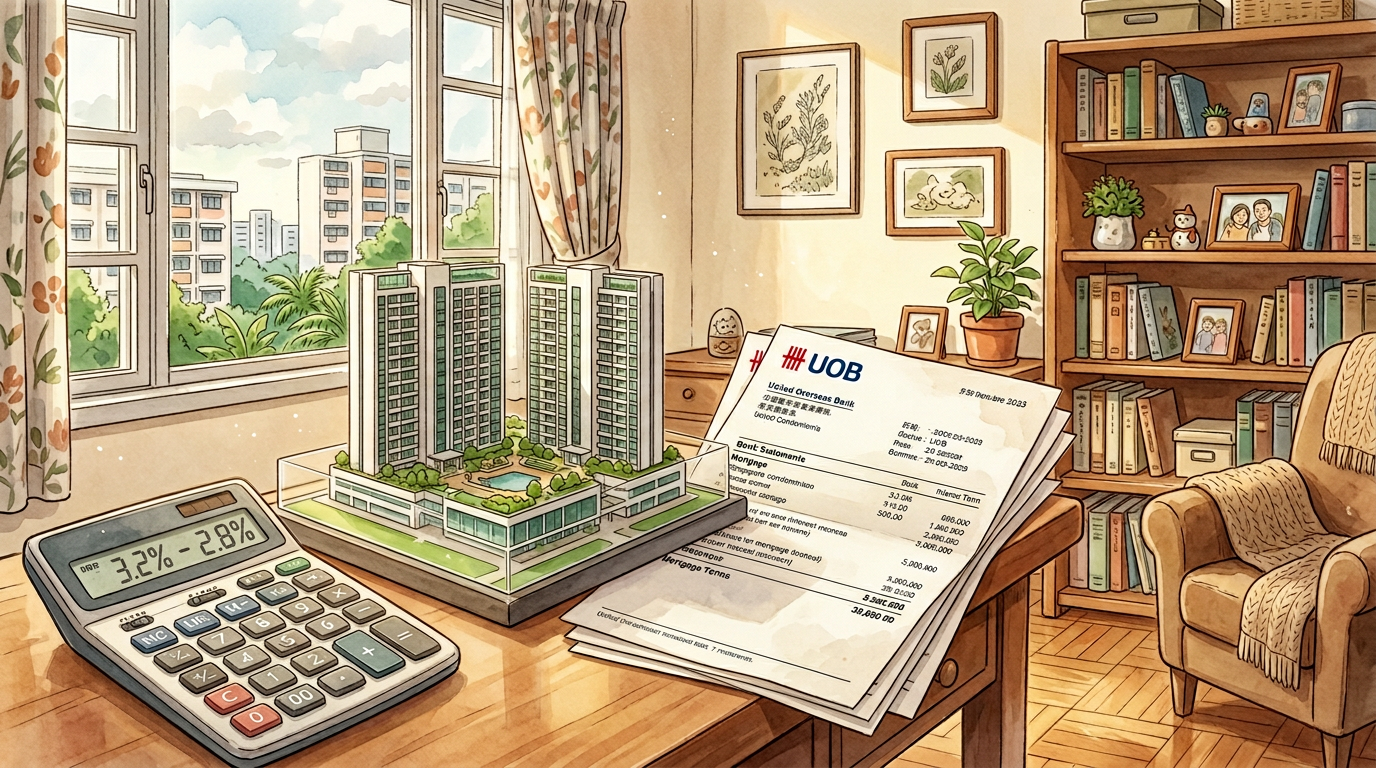
Common Mortgage Mistakes First Time Buyers Make in Singapore usually fall into five buckets: misjudging affordability, skipping proper loan checks, choosing the wrong loan structure, misusing CPF, and ignoring future risks like rising rates or job changes. Avoiding these mortgage traps helps you protect your savings, keep your monthly payments safe, and qualify smoothly for your first home loan.
This article is a focused part of Homejourney’s first-time buyer and mortgage education pillar, complementing guides such as HDB Loan vs Bank Loan and BTO financing. Here, we zoom in on specific first buyer mistakes and costly home loan errors so you can make safer, better-informed decisions before you commit to a 20–30 year mortgage.
1. Underestimating Total Borrowing Costs (Beyond Just the Instalment)
The most common mortgage mistake first-time buyers make is focusing only on the headline interest rate or monthly instalment and ignoring the full cost of owning a home in Singapore. In practice, your monthly cash outflow includes loan payments, insurance, property taxes, conservancy or MCST fees, and ongoing maintenance.
For example, a young couple buying a S$650,000 4-room resale HDB in Tampines might estimate a S$2,300 monthly bank instalment, but forget: town council S&CC of about S$70–S$100, home insurance, and potential renovation loan repayments. For a private condo in Punggol or Sengkang at S$1.3 million, monthly MCST can easily be S$300–S$450, plus higher property tax. These add up quickly and are a frequent new buyer pitfall.
Key cost components many first-time buyers miss
- Buyer’s Stamp Duty (BSD) and, where applicable, Additional Buyer’s Stamp Duty (ABSD) – see IRAS for current tiers.
- Legal and conveyancing fees – often S$2,000–S$3,000 for a typical purchase.
- Valuation fees for bank loans – usually a few hundred dollars.
- Home and fire insurance, and mortgage insurance (HPS for HDB or private mortgage insurance).
- Renovation, furnishings and appliances – easily S$30,000–S$80,000 depending on unit size and condition.
Homejourney’s affordability and eligibility calculators at Bank Rates and Mortgage Rates help you stress‑test not just the loan, but your overall monthly housing costs. As a safety rule, many prudent buyers in Singapore keep total housing outflow (cash + CPF) at or below 30–35% of gross household income, even if MAS’ Total Debt Servicing Ratio (TDSR) allows up to 55%.
Actionable steps to avoid this mistake
- List every cost from down payment to renovation and ongoing monthly expenses before shortlisting homes.
- Use Homejourney’s mortgage calculator at Bank Rates to model different loan amounts, tenures, and interest rates.
- Plan for at least 6–12 months of emergency savings in cash to cover instalments if income drops.
2. Ignoring TDSR, MSR and Loan Eligibility Rules
Another major mortgage trap is assuming the bank will lend based on the property price or your gross salary alone. In Singapore, MAS regulations – especially TDSR (Total Debt Servicing Ratio) and MSR (Mortgage Servicing Ratio) – directly cap how much you can borrow.
As of 2026, TDSR is capped at 55% of your gross monthly income for all property loans. For HDB flats and Executive Condos bought with bank loans, MSR caps your housing instalment at 30% of your income. Existing car loans, student loans, and credit card debt are all counted in this calculation. MAS details these rules on its official site Business Times Property often cites changes in macroprudential policies.
Common first buyer mistakes with eligibility
- Signing an Option to Purchase (OTP) before securing In‑Principle Approval (IPA), then discovering the bank won’t lend enough.
- Overlooking existing debts (car, renovation, personal loans) that significantly reduce loan eligibility.
- Not factoring in income variability (commissions, bonuses, self‑employment income) that banks may haircut.
For instance, a buyer earning S$6,000 with a S$700 car instalment may find their maximum housing loan is materially lower than a colleague with the same salary but no debts. Homejourney’s pre‑assessment via Bank Rates can help you estimate your safe borrowing limit before you pay an OTP fee.
How to stay safely within the rules
- Always obtain an IPA from at least one bank before paying any OTP fee.
- Disclose all existing loans honestly; hiding them only delays approval and risks rejection.
- Use Homejourney’s eligibility calculator at to simulate different income and debt scenarios.
3. Choosing the Wrong Loan Type or Tenure
Many first-time buyers focus on the lowest advertised rate and overlook other terms that can lead to costly home loan errors later. Two common new buyer pitfalls are: picking an unsuitable fixed or floating package, and choosing an unrealistic loan tenure.
Fixed vs floating: not understanding SORA and lock‑in
Most bank loans in Singapore are either fixed‑rate for an initial period or pegged to a floating benchmark such as SORA (Singapore Overnight Rate Average). A common mistake is choosing a very low introductory floating rate without realising it can rise quickly, or locking into a fixed rate longer than necessary and paying penalties for refinancing.
The chart below shows recent interest rate trends in Singapore:
Looking at recent SORA movements helps you understand that today’s low rate may not last. Homejourney tracks live 3M and 6M SORA on Bank Rates , so you can see how DBS, OCBC, UOB, HSBC, Standard Chartered, Maybank and other partners price their packages against these benchmarks.
Tenure mistakes first-time buyers often make
- Choosing the maximum 30‑year tenure to minimise monthly payments, but paying much more interest overall.
- Taking an overly short tenure that strains monthly cashflow and leaves no buffer for emergencies.
- Ignoring how age affects maximum tenure; for example, taking a loan at 45 usually means a shorter tenure and higher monthly instalment.
A balanced approach many prudent Singapore buyers use is to choose a longer tenure initially for flexibility, then make partial prepayments (respecting lock‑in clauses and prepayment penalties) when income rises. For HDB loans, there is no early repayment penalty; for bank loans, there usually is during the lock‑in period, which Homejourney highlights clearly for each package at Bank Rates .
Decision framework: picking a safer loan
- If your budget is tight and you value stability, consider a 2–3 year fixed package from a major bank like DBS, OCBC, or UOB.
- If you have strong cash reserves and can tolerate fluctuations, a SORA‑pegged package may save interest in some rate cycles.
- Target a tenure where your monthly instalment is comfortable at a stress‑tested rate (e.g., 1.5–2 percentage points higher than today).
4. Misusing CPF and Underinsuring the Mortgage
CPF is a powerful tool, but misusing it is one of the most expensive mortgage mistakes to avoid. First-time buyers often drain their CPF Ordinary Account (OA) to minimise cash outlay, without considering that CPF used plus accrued interest must be refunded when they sell the property.
For example, a couple buying a S$500,000 HDB in Yishun may use almost all of their combined OA balances for down payment and stamp duty. Years later, when upgrading to a S$1 million condo, they realise a large portion of their sale proceeds must go back into CPF, leaving less cash for the next down payment. The CPF Board explains these refund rules clearly on its site, but they are frequently overlooked by first-time buyers.
CPF usage mistakes and how to avoid them
- Using CPF for everything (down payment, stamp duty, monthly instalments) and ending up with little CPF left for retirement.
- Not tracking the accrued interest that must be refunded to CPF when the property is sold.
- Ignoring the Basic Retirement Sum and future CPF rules when planning upgrades.
A safer approach is to balance CPF and cash usage: many financially conservative buyers in Singapore choose to pay part of their monthly instalment in cash so that some OA savings continue to grow at 2.5% interest. Homejourney’s guides, such as HDB Loan vs Bank Loan: First-Time Buyer Guide | Homejourney and BTO Buyer Complete Financing Guide | Homejourney 2026 , explain CPF strategies in more detail for BTO and resale buyers.
Underestimating insurance and protection
Another common mortgage trap is neglecting insurance. For HDB buyers using CPF, the Home Protection Scheme (HPS) is usually automatic, but for bank loans or private properties in places like Queenstown, Pasir Panjang or Upper Thomson, you must arrange mortgage insurance yourself. Some couples also forget to review life and critical illness cover after taking a large joint mortgage.
To protect your family, consider:
- Ensuring HPS cover is adequate if you have an HDB loan.
- Buying mortgage reducing term assurance (MRTA) or similar for private or bank‑financed properties.
- Reviewing your overall insurance portfolio when you increase your debt.
5. Skipping Professional Advice and Proper Comparison
The last major mistake is treating a mortgage like a simple commodity purchase and not seeking structured advice. Home loans in Singapore involve bank‑specific policies, legal paperwork, and timing issues (e.g., aligning OTP exercise dates with loan approval and disbursement). Relying only on hearsay or outdated forum posts can lead to costly delays or penalties.
Comparison mistakes first-time buyers often commit
- Comparing only headline interest rates and ignoring fees, lock‑in, and clawback clauses.
- Assuming one bank is always cheapest; in reality, DBS, OCBC, UOB, HSBC, Standard Chartered, Maybank, CIMB, RHB and others adjust packages frequently.
- Not checking if packages differ for HDB vs private properties, or for completed versus under‑construction projects.
Homejourney’s bank rates page at Bank Rates lets you view current rates from all major Singapore banks, calculate eligibility instantly using Singpass/MyInfo, and submit a single application that goes to multiple banks. Our verified mortgage brokers can explain fine print like subsidies, clawbacks, and repricing options, helping you avoid hidden traps.
Safe process flow for first-time buyers
- Use Homejourney’s affordability calculator at to determine a safe price range.
- Browse suitable homes with Property Search so your property shortlist matches your loan capacity.
- Apply for IPA through Bank Rates using Singpass/MyInfo to speed up verification.
- Only then proceed to negotiate and pay for an OTP, aligning timelines with your lawyer and bank.
6. Overlooking Future Plans and Exit Strategy
Many first-time buyers plan only for the next 3–5 years, but your mortgage is a long‑term commitment. Buying a compact one‑bedder near Tanjong Pagar for convenience today, for example, may not suit you if you plan to have children soon. Similarly, taking a large loan right up to the TDSR limit may close doors to future car loans, education loans, or investment properties.
New buyer pitfalls related to future planning
- Ignoring Minimum Occupation Period (MOP) rules for HDB flats, which affect when you can sell or buy another property.
- Not considering resale demand and liquidity – some projects have thinner buyer pools, which matters if you need to sell during a downturn.
- Assuming income will always rise; recent news from Straits Times Housing News shows that job markets can change quickly across sectors.
Before committing, think about a realistic exit strategy: if you had to sell within 5–7 years, is the property likely to be attractive to future buyers? Use Projects and Projects Directory on Homejourney to study project data, transaction histories, and neighbourhood dynamics. This helps you avoid a situation where your mortgage is safe on paper, but your equity is locked in an illiquid asset.
7. Summary: The 5 Biggest Mortgage Traps to Avoid
To recap, the most common mortgage mistakes first-time buyers make in Singapore are:
- Underestimating total costs, including taxes, fees and monthly outgoings.
- Ignoring TDSR/MSR rules and skipping proper loan pre‑approval.
- Choosing unsuitable loan types or tenures without stress‑testing rates.
- Over‑relying on CPF and underinsuring the mortgage.
- Skipping professional comparison and planning, and not thinking about future exit strategies.
Homejourney is built to help you avoid these costly home loan errors through transparent rate comparison, verified data, and a structured process that keeps your safety first. For a broader perspective on planning your first purchase, including grants, loan types and CPF usage, refer to our main first‑time buyer financing pillar: 7 Common Mortgage Mistakes First-Time Buyers Make in Singapore | Homejourney and related guides in our First-Time Buyers series.
FAQ: Common Mortgage Mistakes First-Time Buyers Make
1. What is the biggest mortgage mistake first-time buyers make in Singapore?
The single biggest mistake is committing to a property before confirming how much they can safely borrow. Many first-time buyers pay an OTP fee and then discover that TDSR/MSR limits, existing debts, or variable income reduce their loan eligibility. Always secure an IPA and run affordability checks on Homejourney’s calculator at before you sign.
2. How much of my income should go to my mortgage?
MAS allows total debt (including your home loan) up to 55% of gross income under TDSR, and up to 30% for MSR‑regulated HDB and EC loans. However, many cautious buyers keep their housing costs to 30–35% of income to maintain flexibility for savings and other expenses. Use Homejourney’s tools at Bank Rates to try different scenarios and find a comfortable range.