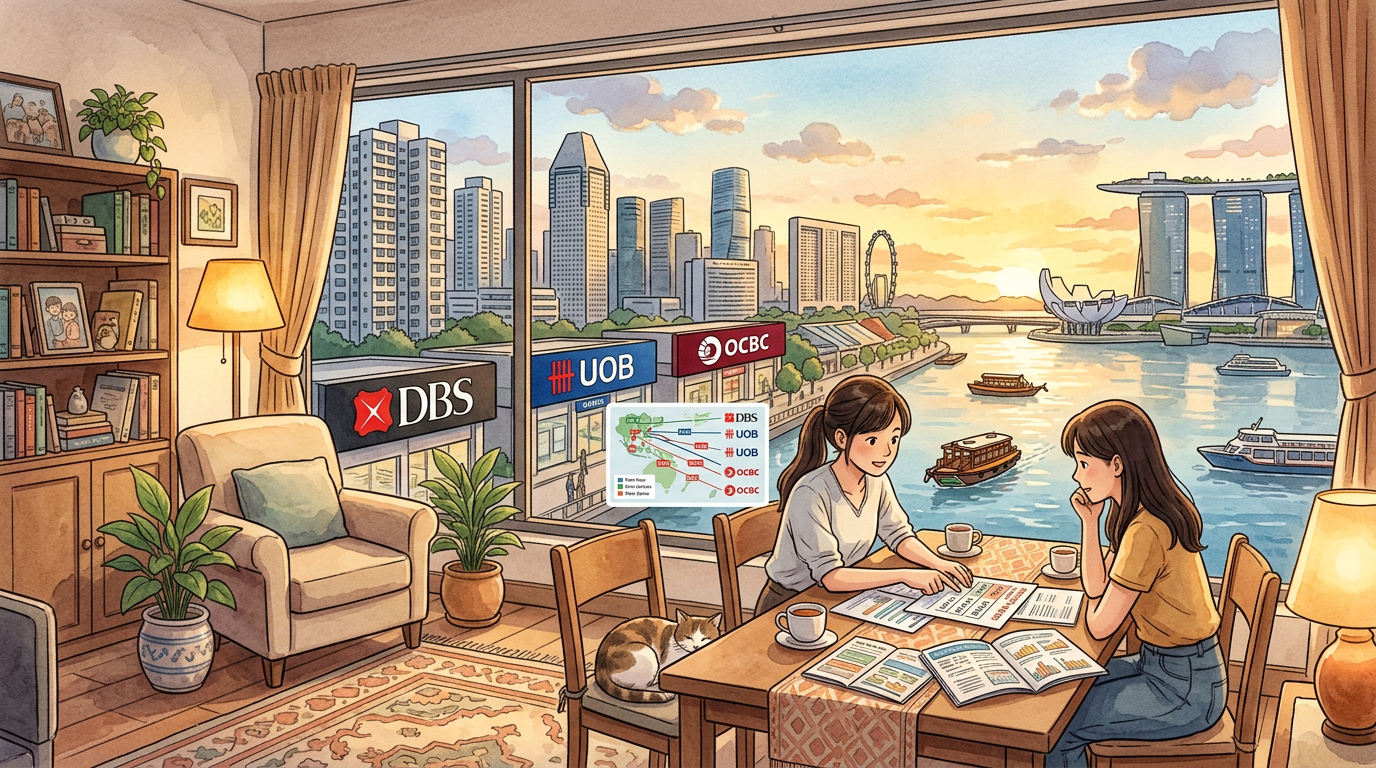
For Singapore borrowers comparing DBS vs Standard Chartered Home Loan Application Process and Timeline, DBS (a local bank) typically moves from pre‑qualification to Letter of Offer in about 2.5–4 weeks, while Standard Chartered (a foreign bank) often takes 5–8 weeks for a similar application, assuming documents are complete and your profile is straightforward. The core steps are similar for both banks—pre‑qualification or In‑Principle Approval (IPA), property valuation, underwriting, Letter of Offer, and legal completion—but the speed, documentation intensity, and user experience differ in meaningful ways.
This focused cluster guide supports Homejourney’s main pillar on Singapore home loans by zooming into the tactical question many buyers ask: “DBS or StanChart for my mortgage, and how long will each process take?” If you are shortlisting bank packages, start by using Homejourney’s mortgage eligibility calculator and rate comparison at Mortgage Rates and to pre‑qualify before deciding between DBS vs Standard Chartered.
DBS vs Standard Chartered: Local vs Foreign Bank Loan Timeline at a Glance
In Singapore, DBS is a local bank with well‑optimised digital processes, while Standard Chartered is a foreign bank whose mortgage workflows often involve more manual checks and documentation. According to Homejourney’s synthesis of common timelines:
- DBS (local bank): From pre‑qualification to Letter of Offer, about 2.5–4 weeks if your documents are complete and the case is straightforward.
- Standard Chartered (foreign bank): Typically 5–8 weeks from initial assessment to Letter of Offer, roughly double the local bank timeline.
- IPA timeline: Local banks like DBS often provide IPA in 1–3 days, sometimes near‑instant online; foreign banks such as SCB usually take 5–10 days.
- Valuation timeline: Local banks 5–7 days vs foreign banks 10–14 days.
- Bank approval: Typical bank approval after full document submission is about 3–10 working days for both, but the total journey differs due to extra steps on foreign bank side.
These ranges are averages based on real Homejourney user journeys across HDB resale flats in towns like Jurong West or Sengkang, and private condos in areas such as Tampines or Queenstown, where buyers often need to match the bank timeline with HDB/URA standard completion windows of roughly 8–12 weeks.
Bank Overview: DBS vs Standard Chartered in the Singapore Mortgage Market
DBS Bank is Singapore’s largest local bank and a dominant player in HDB and private home financing, with strong integration to Singpass/MyInfo and mature digital banking tools. DBS commonly offers SORA‑pegged floating packages, fixed‑rate packages, and occasionally board‑rate products, all subject to MAS rules on Total Debt Servicing Ratio (TDSR) and Loan‑to‑Value (LTV). For most home loans, DBS requires a minimum loan size (commonly around S$100,000) and a DBS/POSB account for disbursement.
Standard Chartered Bank (SCB) operates in Singapore as a foreign bank and focuses more on niche segments such as higher‑income professionals, investors with complex profiles, and international borrowers. As a foreign bank, SCB’s lending criteria and documentation requirements can be more extensive and the timeline longer, though it can be attractive for certain income or asset structures. SCB also offers SORA‑linked and fixed packages, but tends to be more selective in underwriting profiles compared to DBS.
From a Homejourney perspective, both DBS and Standard Chartered are part of the broader multi‑bank comparison you can access via Mortgage Rates and , alongside OCBC, UOB, HSBC, Maybank, CIMB, RHB, Public Bank, Hong Leong Bank, and Citibank.
Interest Rate Types and SORA Context for DBS vs SCB Comparison
Most current DBS and Standard Chartered home loans revolve around three main interest structures:
- SORA‑pegged floating rates: Based on the Singapore Overnight Rate Average (SORA), published daily by MAS, with a bank‑specific spread added on top.
- Fixed‑rate packages: A fixed interest rate for a lock‑in period (commonly 2–3 years), after which the loan usually reverts to a SORA‑linked or board rate.
- Board‑rate packages: Pegged to the bank’s internal reference rate, subject to periodic revision; now less common versus SORA in Singapore’s regulatory context.
DBS, as a local bank, tends to offer more SORA‑linked choices with competitive spreads and lock‑in options, while SCB may emphasise selected fixed‑rate and SORA packages catering to specific borrower profiles. MAS encourages transparency around benchmark‑linked loans, and borrowers must ensure they understand how SORA moves over time and how it affects repayments.
The chart below shows recent interest rate trends in Singapore:
As you can see from typical SORA charts, rates have fluctuated in the past 6–12 months, which directly impacts floating‑rate repayments. Homejourney’s real‑time SORA tracking at Mortgage Rates helps you monitor 3M and 6M SORA so you can time your DBS or StanChart choice more confidently.
Step‑by‑Step Application Process: DBS vs Standard Chartered
Although each bank has unique workflows, the core mortgage application steps in Singapore are broadly similar. Below is a practical comparison of what you can expect with DBS vs Standard Chartered, framed around a typical HDB or private purchase.
Step 1: Pre‑Qualification & In‑Principle Approval (IPA)
DBS (local bank)
- Use Homejourney’s mortgage eligibility calculator at Mortgage Rates to estimate borrowing power under MAS TDSR (usually capped at 60%).
- Submit DBS IPA digitally via Singpass/MyInfo, often taking same day to 1–3 days for a response if documents are clear.
- For many Homejourney users living in neighbourhoods like Punggol or Bishan, DBS IPA arrives before the weekend if submitted early in the working week.
Standard Chartered (foreign bank)
- Pre‑qualification usually involves more detailed discussion, especially if you have overseas income or multiple properties.
- IPA timeline is typically 5–10 days, reflecting additional checks by SCB’s underwriting teams.
- Expect more back‑and‑forth if you have complex income (e.g., bonus‑heavy packages in Raffles Place or expatriate income credited overseas).
Step 2: Property Selection and OTP / HDB Resale Submission
Once you have an IPA from either DBS or SCB, you can confidently shortlist properties within budget using Homejourney’s property search at Property Search . Many buyers target staying near parents in Jurong West or shortening their commute to areas like Tanjong Pagar or one‑north.
- Private property: You negotiate price, then secure the Option to Purchase (OTP), usually with a 1% option fee.
- HDB resale: You proceed via the HDB Resale Portal, where completion timelines are structured around HDB’s standard 8–12 week window.
Step 3: Full Loan Application & Documentation
Most banks in Singapore—including DBS and Standard Chartered—require similar core documents:
- NRIC/passport
- Latest 3–6 months payslips
- Latest IRAS Notice of Assessment
- 12‑month CPF contribution history
- CPF OA statement if using CPF for downpayment
- Option to Purchase or Sale & Purchase Agreement
- Statements for existing loans and credit cards
DBS tends to accept fully digital submissions via digibank and MyInfo, making it easier if you are juggling work in the CBD and viewings after office hours. Standard Chartered, as a foreign bank, may request additional original documents or clarifications, especially for self‑employed borrowers or those with overseas pay slips, which can stretch the timeline.
Step 4: Bank Processing, Valuation, and Underwriting
Once documents are in, the bank initiates underwriting and property valuation.
- DBS: Typical processing and valuation takes 5–7 days, with overall approval commonly within 3–10 working days when documentation is complete.
- Standard Chartered: Processing and valuation may require 10–15 days, with a heavier emphasis on credit checks and income verification.
For a resale HDB in Sengkang or a condo in Pasir Ris, this stage usually fits within the OTP validity period (often 14–21 days for private property), but you must avoid delays by responding promptly to document requests.
Step 5: Letter of Offer and Acceptance
After approval, both DBS and SCB issue a Letter of Offer that outlines loan amount, interest rate structure (SORA vs fixed vs board), lock‑in period, prepayment penalties, and subsidies.
- DBS: Letter of Offer typically arrives within 2–3 days after approval; many borrowers sign within the standard 7‑day acceptance window.
- SCB: Letter of Offer may take 5–10 days after approval, especially if cross‑border checks are involved.
At this point, use Homejourney’s multi‑bank request flow at to compare DBS vs Standard Chartered and other banks side by side, letting lenders compete for your business while you check total costs, lock‑ins, and penalties.
Step 6: Legal, Completion, and Key Collection
Once the Letter of Offer is signed, legal conveyancing, mortgage registration, and fund disbursement proceed according to HDB and URA timelines.
- Legal completion for resale HDB and private property: commonly 8–12 weeks from exercising OTP or HDB acceptance.
- DBS and SCB both coordinate with your lawyer; the difference is more in the speed of prior stages than in legal completion itself.
After completion, many homeowners on the East‑West Line stretch from Clementi to Bedok plan move‑in logistics, including essentials like air‑conditioning servicing. You can explore post‑move support such as aircon services via Aircon Services to ensure your unit is comfortable from day one.
Pros and Cons: DBS vs Standard Chartered Home Loan Application Experience
Choosing between DBS vs Standard Chartered is not only about headline interest rates; the application process and timeline can significantly affect your stress level and transaction certainty. Below is a balanced DBS SCB comparison focused on process and user experience.
DBS (Local Bank) – Strengths and Limitations
- Strengths:
- Faster average timeline (2.5–4 weeks to Letter of Offer), well‑suited for tight OTP windows.
- Strong digital experience via digibank and Singpass/MyInfo submission.
- Familiarity with typical HDB and private transactions, including many cases in mature estates like Ang Mo Kio and Toa Payoh.
- Limitations:
- Standardised underwriting may be less flexible for highly complex or international income structures.
- Popular packages can change quickly as SORA moves; you must monitor rates regularly.
Standard Chartered (Foreign Bank) – Strengths and Limitations
- Strengths:
- May offer attractive structures or niche packages for certain income profiles or higher‑net‑worth borrowers.
- Can be competitive for investment properties or borrowers with strong overseas credit histories.
- Limitations:
- Longer timeline (5–8 weeks), especially for IPA and valuation stages.
- More documentation, occasionally requiring original copies or additional explanations.
- Potentially less straightforward for first‑time HDB buyers needing fast, predictable milestones.
For first‑time buyers in estates like Punggol or Woodlands, DBS generally offers a smoother, faster journey. For investors with complex profiles, SCB can be worth considering. Homejourney’s comparison tools at Mortgage Rates and related guides like DBS vs Standard Chartered Home Loan Singapore: Side‑by‑Side Guide | Homejourney and Best Bank Home Loan Rates Singapore: Lowest Rate vs Best Deal | Homejourney help you weigh these trade‑offs objectively.
Local vs Foreign Bank Loan: When to Choose DBS or StanChart
The local vs foreign bank loan
- Choose DBS (local bank) if