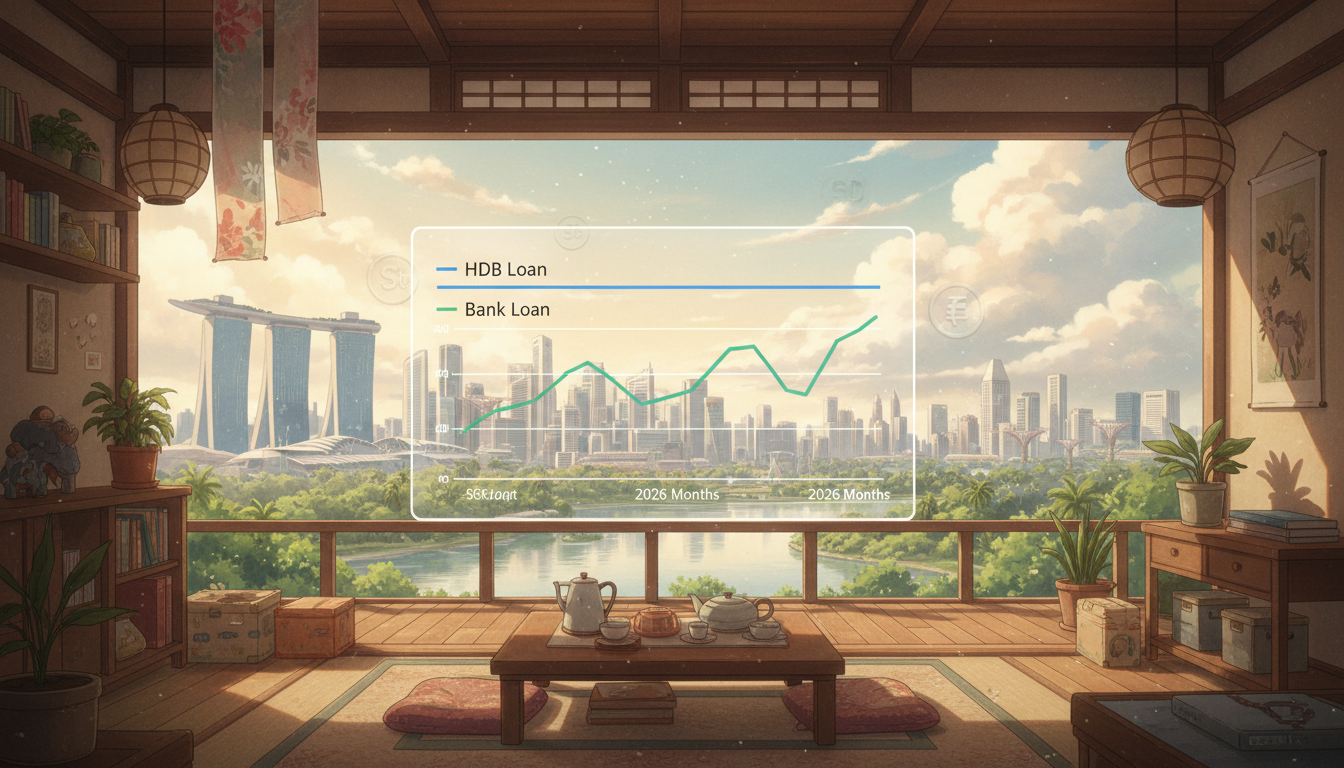
For most buyers in 2026, the key difference in an HDB Loan vs Bank Loan 2026 Comparison is stability versus savings: HDB’s concessionary rate remains at 2.6% p.a., while competitive bank packages for HDB flats are hovering around 1.5%–1.7% p.a. for SORA-pegged loans and about 1.8%–2.0% p.a. for fixed packages.[2][4] In plain terms, HDB loans offer predictability and flexibility, while bank loans can give you sizeable interest savings but come with more conditions and risks.[2][3][4]
This article is a focused cluster guide under Homejourney’s main HDB financing pillar, “HDB Loan vs Bank Loan 2026: Homejourney Comparison” HDB Loan vs Bank Loan 2026: Homejourney Comparison . It zooms into the numbers, risks, and decision frameworks you need to safely choose between HDB and bank financing in 2026, and shows how to use Homejourney tools to compare rates, check eligibility, and apply securely.
Quick answer: When to pick HDB loan vs bank loan in 2026
If you want maximum safety and predictability and expect to hold your flat long term with minimal refinancing, the best HDB loan for you is still the standard HDB concessionary loan at 2.6% p.a., especially if you are a first-time buyer who values certainty over the absolute lowest rate.[2]
If you are comfortable with some interest rate movement, have stable income, and plan your finances actively, a bank loan from DBS, OCBC, UOB, HSBC, Standard Chartered, Maybank, CIMB, RHB, Public Bank, Hong Leong Bank or Citibank can potentially save you tens of thousands of dollars over your loan tenure at 2026 rates around 1.6% p.a. for SORA-pegged packages.[3][4]
However, once you refinance from HDB to a bank, you cannot switch back to an HDB loan for the same flat, so you should compare carefully and decide with full information.[4] Homejourney’s bank rates comparison feature at Bank Rates lets you safely compare real-time offers from all major banks before committing.
Core differences: HDB Loan vs Bank Loan 2026 Comparison
The table below summarises the key differences for an HDB flat buyer in 2026 based on official HDB/CPF guidance and current market conditions.[2][4]
What are HDB home loan rates in September 2026?
For most of 2024–2026, the HDB concessionary rate has stayed at 2.6% p.a. because it is pegged at 0.1% above the CPF Ordinary Account (OA) rate, which has remained at 2.5% p.a. according to CPF Board.[2][4] Unless CPF OA rates change, HDB home loan rates September 2026 are expected to remain at 2.6% p.a.
In everyday terms, if you are buying a 4-room resale in Tampines for around $650,000, a 75% HDB loan of $487,500 over 25 years at 2.6% means a monthly instalment of roughly $2,200–$2,250, depending on the exact tenure and rounding. This is very close to the example of a $500,000 loan at 2.6% giving about $2,268 per month.[4]
For deeper analysis of rate movements and policy changes, you can refer to Homejourney’s dedicated article “HDB Loan Interest Rate Trends 2026: Homejourney Analysis” HDB Loan Interest Rate Trends 2026: Homejourney Analysis and “HDB Loan Interest Rate Trends Analysis 2026: Homejourney Insights” HDB Loan Interest Rate Trends Analysis 2026: Homejourney Insights .
How do bank HDB mortgage rates compare in September 2026?
As of early 2026, the 3‑month compounded SORA is about 1.11% p.a., and banks typically add a spread of around 0.5%, giving an effective rate of roughly 1.6% p.a. for SORA-pegged HDB mortgage packages.[4] Some promotional fixed-rate packages from DBS, OCBC, UOB and others have been in the 1.8%–2.0% p.a. range for lock‑ins of 2–3 years.[3][4]
Compared with HDB’s 2.6%, that is roughly a 1.0% difference. For a $500,000 loan:
This saves about $244 per month, or about $2,928 per year on the same loan amount.[4] Over just five years, that can exceed $14,000 in interest savings, before legal and valuation fees.
To compare live bank offers safely, you can use Homejourney’s real-time bank rates page at Bank Rates . Homejourney continuously monitors and verifies rates from DBS, OCBC, UOB, HSBC, Standard Chartered, Maybank, CIMB, RHB, Public Bank, Hong Leong Bank and Citibank so users do not have to manually check each bank one by one.
Understanding SORA and interest rate trends in 2026
SORA (Singapore Overnight Rate Average) is the main benchmark for floating home loans in Singapore. MAS publishes SORA and banks price many HDB and private property loans as SORA + spread, where the spread is the bank’s margin.[2][4] When SORA falls, your interest rate generally falls; when it rises, your instalments increase.
The current environment (mid‑2026) is a transition from the high‑rate cycle post‑2022. SORA has eased from its peaks, making bank loans more attractive again compared with HDB’s fixed 2.6%.[3][4] But SORA can still move, so borrowers must be ready for future fluctuations during and after their lock‑in periods.
The chart below shows recent interest rate trends in Singapore:
When you view similar charts inside Homejourney’s tools, it helps you decide whether to lock in a fixed rate now or choose a floating SORA package based on your risk appetite.
Real-world example: Pasir Ris couple choosing between HDB and bank loan
Consider a young couple buying a 4‑room resale flat in Pasir Ris near Elias Mall, priced at $650,000. They plan to stay long term but may upgrade to an EC in Punggol or Tampines North in 8–10 years.
Assume a 75% loan of $487,500:
- HDB loan (2.6%, 25 years): Monthly instalment around $2,200–2,250, stable for many years.
- Bank SORA loan (1.6%, 25 years): Monthly instalment around $2,000–2,050, saving roughly $200–$250 per month, but subject to SORA movement after any fixed period ends.[4]
If they are both working in Changi Business Park and value cash flow for childcare and daily commuting (Pasir Ris MRT to Expo is about 15–20 minutes on the East‑West Line with a transfer to the Downtown Line), the interest savings from a bank loan can meaningfully improve their monthly budget. However, if one partner is on a contract job or they foresee career breaks, they may prefer HDB’s stability to avoid surprises.
This is where Homejourney’s mortgage eligibility calculator at Mortgage Rates and the detailed HDB Loan Eligibility 2026 guide HDB Loan Eligibility 2026: Who Qualifies & How Much | Homejourney help you understand how much buffer you truly have before choosing a more volatile package.
Pros and cons: HDB loan in 2026
Advantages of HDB loan
- Predictable rate at 2.6% p.a. – The rate has been unchanged for many years, giving strong repayment certainty.[2]
- No lock-in period – You can fully or partially repay anytime, or refinance to a bank loan with no penalty.[2]
- Flexible CPF usage – You can use CPF OA extensively for downpayment and instalments, subject to HDB and CPF rules.[2]
- Lower cash requirement – Unlike bank loans, you do not need a compulsory 5% cash downpayment.[1][2]
- Government-backed structure – Especially reassuring for first‑time buyers who prioritise safety and stability.
Disadvantages of HDB loan
- Higher rate than 2026 bank packages – You may be paying roughly 1% more per year than competitive bank loans.[3][4]
- Shorter maximum tenure (25 years) – Bank loans can stretch up to 30 years, subject to MAS rules, which can reduce monthly instalments at the cost of more total interest.[2]
- Eligibility restrictions – Income ceiling and citizenship conditions apply; not everyone qualifies.[2]
Pros and cons: Bank loan in 2026
Advantages of bank loan
- Lower headline rates in 2026 – SORA-pegged rates around 1.6% and fixed rates around 1.8%–2.0% are substantially lower than 2.6%.[3][4]
- Longer tenure – Up to 30 years for HDB flats can reduce monthly outlay.[2]
- More product choices – Fixed, floating (SORA), and hybrid structures across DBS, OCBC, UOB, HSBC, Standard Chartered, Maybank, CIMB, RHB, Public Bank, Hong Leong Bank, and Citibank.
- Refinancing flexibility between banks – You can move to another bank after the lock‑in to chase better rates, subject to costs.
Disadvantages of bank loan
- Rate volatility – Floating packages and post–lock‑in periods expose you to rate increases.[2][3]
- Lock-in penalties – Early partial or full repayment within the lock‑in can incur penalties of about 1.5% of outstanding amount.[2]
- 5% cash downpayment – You must have sufficient liquid cash, not just CPF.[1][2]
- No way back to HDB loan – Once you switch to a bank loan, you cannot return to the HDB concessionary loan for that flat.[4]
How to evaluate: HDB Loan vs Bank Loan in 5 steps
To make a safe decision, Homejourney recommends a simple 5‑step framework you can follow before signing anything:
- Check your eligibility and budget
Use Homejourney’s mortgage calculator at Mortgage Rates to estimate how much you can borrow under MAS’s Total Debt Servicing Ratio (TDSR) and HDB’s Mortgage Servicing Ratio (MSR) rules. Cross‑check with HDB’s own calculators and eligibility conditions, and refer to HDB Loan Eligibility 2026References