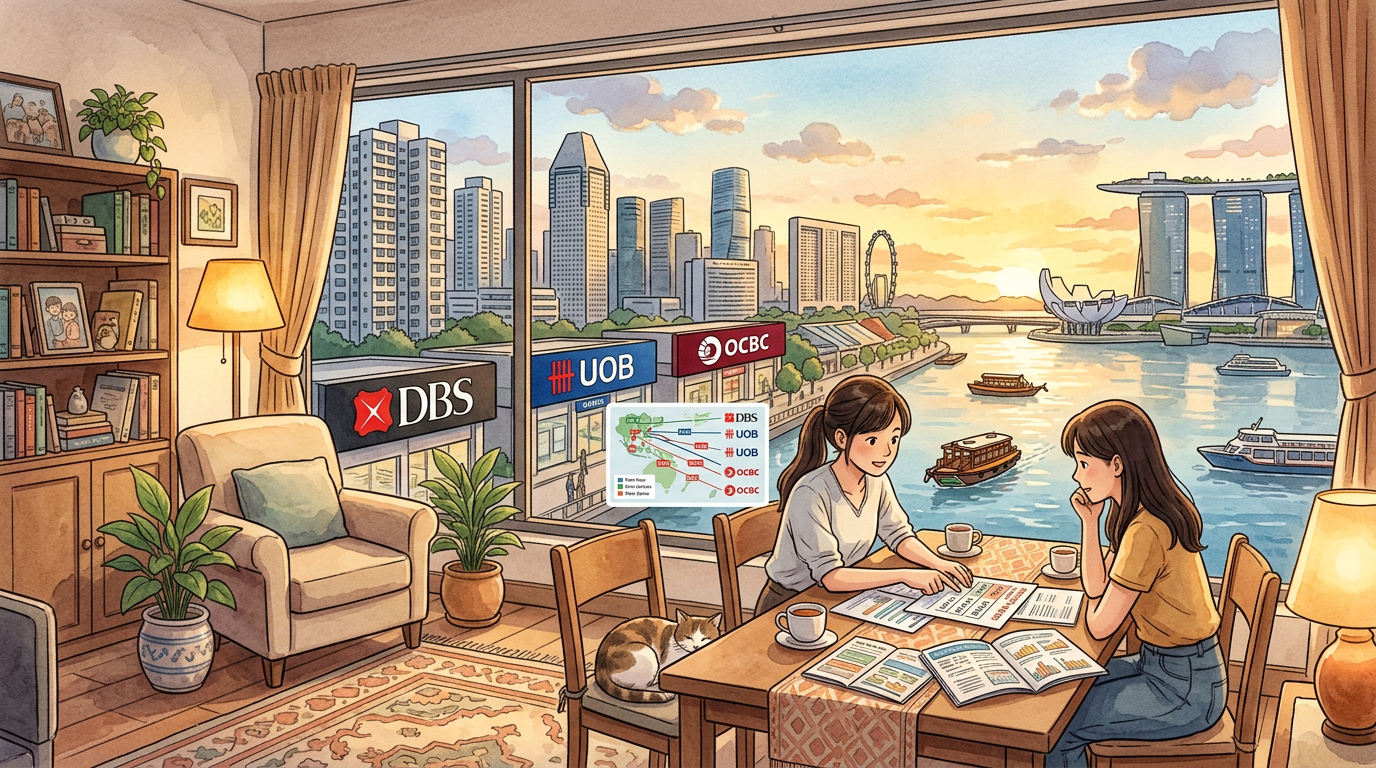
To secure the lowest bank rate home loan Singapore, most buyers follow a clear sequence: check eligibility, get In-Principle Approval (IPA), commit to a property, then complete full bank application and legal completion over about 3–6 weeks.
Homejourney streamlines this entire Lowest Bank Rate Home Loan Singapore Application Process and Timeline by helping you compare bank home loan rates, calculate affordability, and submit one request so multiple banks can compete for your mortgage.
How this cluster guide fits into Homejourney’s mortgage pillar
This article is a focused cluster under Homejourney’s main pillar on lowest mortgage rate Singapore and Singapore home loan education.
While the pillar guide explains rates, fees, TDSR, and loan types in depth, this cluster zooms into the application process and timeline for securing the cheapest home loan from DBS, OCBC, UOB, HSBC, Standard Chartered, Maybank, CIMB, RHB, Public Bank, Hong Leong Bank, and Citibank.
For detailed rate and fee analysis, you can refer to the related pillar and cluster articles like "Lowest Bank Rate Home Loan Singapore: Rates & Fees Explained" Lowest Bank Rate Home Loan Singapore: Rates & Fees Explained | Homejourney and "Lowest Bank Rate Home Loan Singapore: Compare Packages with Homejourney" Lowest Bank Rate Home Loan Singapore: Compare Packages with Homejourney .
Step 1: Check your eligibility and borrowing power
Before comparing the best bank mortgage package, start with a realistic view of how much you can borrow under MAS rules.
In Singapore, the Total Debt Servicing Ratio (TDSR) is generally capped at 55% of your gross monthly income for private housing loans, while HDB buyers must also meet the Monthly Servicing Ratio (MSR) cap of 30% for the mortgage on the flat.
Locals know this step often determines whether you can comfortably buy that three-bedroom condo in Tampines (walking 7–8 minutes from Tampines MRT via Exit B) or if you should instead consider a four-room resale HDB in Bedok, where monthly instalments can be significantly lower.
Use Homejourney’s mortgage eligibility calculator
For a safe, trusted way to check your borrowing power, use Homejourney’s mortgage tools at Mortgage Rates .
Key features include:
- Eligibility calculator: Instantly estimate your maximum loan based on income, age, existing debts, and typical TDSR/MSR limits.
- Repayment calculator: See monthly instalments for different rate types (SORA-pegged floating, fixed, board rates) and tenures.
- Real-time SORA tracking: Track live 3M and 6M SORA so you can time floating-rate decisions more confidently.
Insider tip: Many East-side buyers, especially couples working in Changi Business Park and Paya Lebar, run several scenarios—like 25-year vs 30-year tenures—before committing to a loan so their monthly instalments stay manageable even if rates rise.
Understanding rate types and current lowest promotions
To truly get the lowest mortgage rate Singapore for your situation, you need to understand how banks price their packages and what promotions are available in 2026.
Most major banks—DBS, OCBC, UOB, HSBC, Maybank, Standard Chartered, CIMB, RHB, Hong Leong Bank, Citibank—offer three broad types of home loans:
- SORA-pegged floating rate: Interest tied to the Singapore Overnight Rate Average (SORA) plus a fixed spread.
- Fixed rate: Interest is fixed for 2–5 years, then usually converts to a floating or board rate.
- Board rate: Rate determined by the bank’s internal board; less transparent and less popular among cautious buyers.
Recent market data in mid-2026 shows the lowest bank rate home loan Singapore for floating packages starting from around 1.27% p.a. (3M SORA + 0.20%) on selected private property loans with HSBC and Maybank, and fixed rates from about 1.40% p.a. for 2-year fixed packages.
For HDB buyers, some banks such as OCBC have been offering competitive floating packages around 3M SORA + 0.25%, roughly 1.32% p.a., though these figures can change quickly. Always verify the latest rates via Homejourney or the official bank sources before applying.
The chart below shows recent interest rate trends in Singapore
To visualise how SORA and mortgage rates have moved in the past months, use the interactive chart below.
As you can see from the chart above, rates have been relatively stable compared to the sharp increase phase of 2023–2024, but small movements can still impact monthly repayments for large loans—especially for owners of $1.5–2 million condos in areas like Queenstown or Novena.
Step 2: Compare bank home loan rates and shortlist packages
Once you understand your borrowing capacity and rate types, your next objective is to compare bank home loan rates across DBS, OCBC, UOB, HSBC, Standard Chartered, Maybank, CIMB, RHB, Public Bank, Hong Leong Bank, and Citibank.
Locally, most buyers used to visit branches at Raffles Place, Tampines, or Jurong East one by one—a process that took days and often resulted in confusion. Homejourney centralises this into a safer, faster comparison experience.
Use Homejourney to compare the cheapest home loan safely
On Homejourney’s mortgage page Mortgage Rates , you can:
- Compare rates from all major banks instantly, including DBS, OCBC, UOB, HSBC, Standard Chartered, Maybank, CIMB, RHB, Public Bank, Hong Leong Bank, and Citibank.
- Filter by rate type (SORA, fixed, board rate), lock-in period, and minimum loan size.
- See real-time promos and limited-time rebates with transparent explanations of fees.
- Request the lowest suitable package through a single multi-bank request, letting banks compete for your business.
Insider tip: If you plan to refinance your existing loan for a resale condo in Bishan or Clementi, short lock-in periods (e.g. 2 years) can be attractive, as they give flexibility to refinance again if rates fall further. However, buyers upgrading from HDB to new launch condos in Punggol often prioritise stability with 3–5 year fixed rates because their budgets are tighter.
Step 3: Get In-Principle Approval (IPA) – 1 to 3 working days
The next milestone in the Lowest Bank Rate Home Loan Singapore Application Process and Timeline is obtaining an In-Principle Approval (IPA) before you commit to a property.
IPA confirms how much a bank is willing to lend you, subject to valuation and final checks. According to typical banking practices and guidance from mortgage experts, IPA can be processed in same day to about 3 working days, depending on the bank and the completeness of your documents.
Documents needed for IPA
Most banks (DBS, OCBC, UOB, HSBC, Standard Chartered, Maybank, CIMB, RHB, Public Bank, Hong Leong Bank, Citibank) will require:
- NRIC (front and back) of all applicants
- Latest 3–6 months computerised payslips
- Latest 12 months CPF contribution history for salaried employees
- Most recent Notice of Assessment (NOA) from IRAS (2 years for self-employed)
- ACRA business profile and financial statements for self-employed or business owners
- Details of other loans and credit cards (for TDSR calculation)
Locals often prepare these ahead of time—many keep soft copies in a secure folder or on cloud storage—so they can submit IPA applications quickly once a promising unit appears on Homejourney’s property search page Property Search .
Applying for IPA via Homejourney vs directly with banks
You can apply for IPA directly with your chosen bank or through Homejourney’s multi-bank system:
- Direct bank IPA: Log in with Singpass/MyInfo on the bank portal (e.g. DBS digibank, OCBC Online Banking, UOB TMRW), fill in income and debt details, upload documents, and wait for the bank’s response.
- Homejourney multi-bank IPA request: Use the same set of documents once, submit through Homejourney’s loan request form at Mortgage Rates , and let multiple banks review your profile in parallel.
From a safety and trust perspective, Homejourney verifies information, standardises data submitted to banks, and clearly explains each offer so you can avoid misunderstandings around lock-in clauses, prepayment penalties, or claw-back conditions.
Step 4: Commit to property (OTP/HDB booking) and full application – 2 to 4 weeks
Once you have IPA and have shortlisted your bank packages, the next stage is committing to the property and completing the full loan application. For private properties, this typically involves signing the Option to Purchase (OTP); for HDB flats, you will go through the HDB portal and obtain or confirm your HDB Flat Eligibility (HFE) and loan choice.
Timeline from OTP to loan approval
The typical application process and timeline after OTP looks like this:
- Day 1–3: Sign OTP or HDB Agreement
For private resale, you pay the option fee (often 1% of purchase price) and sign the OTP—e.g. a $20,000 fee for a $2 million condo near Buona Vista MRT. - Day 3–7: Property valuation and full document submission
The bank orders a valuation (fee often in the $500–$1,000 range) and requests full documents: OTP/Sale & Purchase Agreement, latest IRAS NOA, updated CPF statements, and any tenancy information if buying an investment unit. - Week 2–3: Underwriting and Letter of Offer (LO)
The bank’s credit team confirms your income, TDSR/MSR, and property valuation before issuing the Letter of Offer, which includes interest rate, spread, lock-in period, legal subsidies, and repricing clauses. - Week 3–4: Acceptance of LO and legal completion
Your lawyer handles conveyancing, stamp duty payment, and coordination with the bank and developer or seller. Legal fees are commonly in the S$2,000–S$3,000 range.
Homejourney users usually track these milestones carefully, especially for projects with tight completion timelines like new launches in Lentor or integrated developments near Woodlands North Coast, where missing a deadline can have financial consequences.
Approval criteria banks look at
Across DBS, OCBC, UOB, HSBC, Standard Chartered, Maybank, CIMB, RHB, Public Bank, Hong Leong Bank, and Citibank, typical approval criteria include:
- Income stability: Consistent salary or business income, supported by payslips and NOA.
- Credit history: Good repayment track record on credit cards, car loans, and personal loans.
- TDSR/MSR compliance: All loans combined stay within MAS caps.
- Property valuation: Bank valuation is adequate versus purchase price.
- Age and tenure: Loan tenure typically capped so it does not exceed age limits (e.g. often up to age 65–75 depending on bank policy).
Insider tip: If you hold multiple credit cards and a car loan, consider reducing limits or paying down some debt before applying; this can improve your TDSR and help you qualify for a larger loan or a better-rate package.
Step 5: Disbursement and move-in timeline
After you accept the Letter of Offer, your lawyer and the bank work together to arrange disbursement of funds to the seller, developer, or HDB. This stage is usually aligned with your completion date and key collection.
How long until funds are disbursed?
For most resale or completed private properties, from LO acceptance to disbursement is about 2–4 weeks, depending on legal processing speed, bank internal processes, and any HDB or developer requirements.
New launch properties follow the progressive payment schedule, where disbursement is made in stages (foundation, superstructure, TOP, CSC), so your loan is gradually drawn down over several years.
Coordinating move-in and post-purchase services
Once keys are collected—whether at the HDB branch in Toa Payoh or the condo’s management office near places like Kovan or Redhill—most owners move quickly to arrange renovations and essential services.
For safe and well-maintained homes, Homejourney can connect you to aircon servicing partners via Aircon Services , ensuring your new unit stays cool in Singapore’s humidity, particularly in sun-facing units where afternoon heat is intense.
Bank-by-bank overview: who suits which borrower?
While specific promotions change frequently, each bank tends to have a typical user profile it serves especially well. Use this as a starting framework, then verify current packages via Homejourney’s comparison tools and the official bank websites.
DBS, OCBC, UOB – mainstream, digitally strong options
DBS Bank is known for strong digital banking (e.g. DBS digibank), quick online IPA, and competitive SORA-linked packages for salaried borrowers.
OCBC Bank often provides attractive HDB-focused floating packages and occasionally offers valuation and legal subsidies for upgraders.
UOB frequently markets fixed-rate packages popular with families buying condos in mature estates like Bishan or Bukit Timah.
HSBC, Standard Chartered, Maybank – aggressive rate promotions
HSBC has been among the banks offering some of the lowest mortgage rates in mid-2026, including competitive 2-year fixed packages and 3M SORA + low spread floating rates.
Standard Chartered and Maybank also run periodic campaigns, sometimes with cash rebates or fee subsidies for larger loans (e.g. above S$1 million) typical in central regions like Orchard, River Valley, or Marina Bay.
CIMB, RHB, Public Bank, Hong Leong Bank, Citibank – niche strengths
CIMB