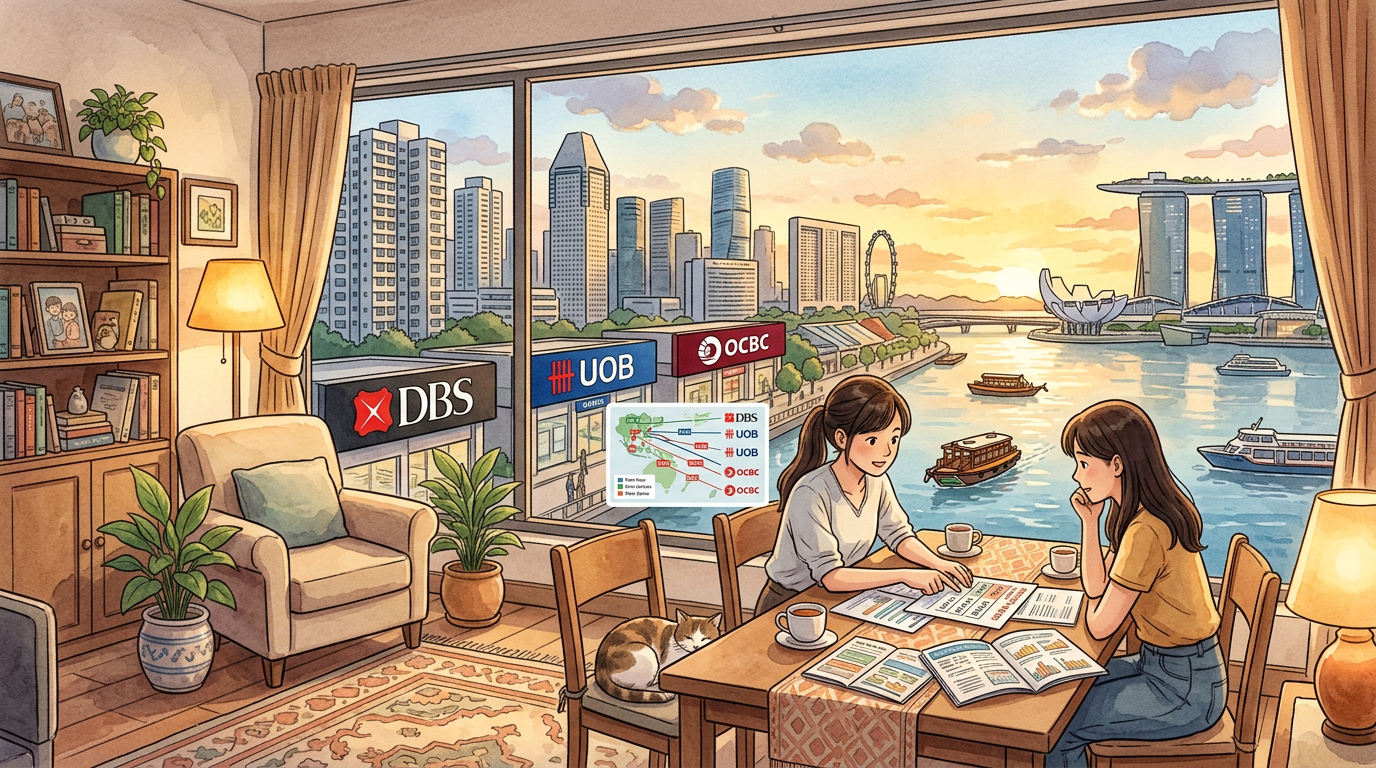
For Singapore buyers comparing DBS vs Standard Chartered Home Loan vs Other Banks, Standard Chartered typically edges DBS on headline rates for both fixed and SORA‑pegged packages, while DBS offers very strong digital banking, branch accessibility and stability, with most other major banks (OCBC, UOB, HSBC, Maybank, CIMB, RHB) clustering closely around their pricing. The best choice for you depends on your property type, risk appetite (fixed vs floating), lock‑in preferences and whether you value slightly lower rates or the convenience and ecosystem of a large local bank.
This cluster article sits under Homejourney’s main Singapore home loan pillar guide, diving specifically into the DBS vs Standard Chartered
Quick snapshot: DBS vs Standard Chartered vs other banks (2026)
Across Singapore’s main banks, 2026 home loan rates are fairly tightly bunched. Independent comparisons indicate:
- 2‑year fixed rates: roughly 2.50–2.85% p.a. across major lenders like DBS, Standard Chartered, OCBC and UOB.
- Floating SORA‑pegged rates: about 2.20–2.50% p.a., assuming 75% LTV for a first private property.
- DBS: indicative 2‑year fixed around 2.60–2.70% p.a., 3‑year fixed 2.75–2.85% p.a., SORA packages ~SORA + 0.80%.
- Standard Chartered (SCB): 2‑year fixed around 2.50–2.65% p.a., 3‑year fixed 2.65–2.80% p.a., SORA ~SORA + 0.70–0.80%.
- Other banks (OCBC, UOB, HSBC, Maybank, CIMB, RHB): generally cluster in similar bands, with occasional promotions slightly undercutting DBS and SCB.
In practice, this means DBS is usually “in the pack”, while Standard Chartered and some foreign banks (HSBC, Maybank) often lead on the very lowest promotional rates, especially for 2‑year fixed packages. However, the difference might be just 0.05–0.15% p.a., so you should compare total cost and flexibility rather than chasing the lowest headline number.
Bank overviews: DBS vs Standard Chartered vs local & foreign peers
DBS Bank is Singapore’s largest local bank, with a strong retail footprint across heartland branches like Toa Payoh, Tampines and Clementi, plus major hubs at Raffles Place and Marina Bay Financial Centre. DBS offers:
- HDB and private property loans (completed and building-under-construction, BUC).
- Fixed rate packages (typically 2‑ or 3‑year lock‑ins).
- SORA‑pegged floating packages and legacy FHR (Fixed Deposit Home Rate) based loans.
- Strong online banking and the DBS digibank app, useful for tracking repayments and making changes.
Standard Chartered Bank (SCB) is a foreign bank with a long presence in Singapore, with flagship branches near Bugis Junction and Scotts Road. It focuses heavily on wealth and mortgage products, offering:
- SCB Home Suite and similar packages for HDB and private properties.
- 2‑ and 3‑year fixed rate loans that often price slightly below DBS.
- 3M and 1M SORA floating packages with competitive spreads and options for no lock‑in or shorter lock‑in periods.
Other banks like OCBC, UOB, HSBC, Maybank, CIMB, RHB, Citibank and regional players offer similar mixes of fixed and SORA packages, with promotional rates shifting month to month. Homejourney’s Mortgage Rates page tracks these changes so you don’t have to monitor each bank separately.
Product comparison: fixed vs SORA, lock‑ins and penalties
When comparing DBS vs Standard Chartered vs other banks, focus on:
- Rate type: fixed vs SORA‑pegged floating.
- Lock‑in period: usually 2 years, occasionally no lock‑in for some floating packages.
- Lock‑in penalty: commonly around 1.5% of outstanding loan if you redeem or refinance during lock‑in.
Fixed rate packages (DBS, SCB, others):
- DBS 2‑year fixed: ~2.60–2.70% p.a..
- SCB 2‑year fixed: ~2.50–2.65% p.a..
- Other banks (OCBC, UOB, HSBC, Maybank): broadly within 2.50–2.80% p.a., with slight promotional variations.
SORA‑pegged floating packages:
- 3M SORA across banks around 1.50–1.70% p.a. in early 2026.
- DBS: about 3M SORA + 0.80%, all‑in roughly 2.30–2.50% p.a..
- SCB: 3M SORA + 0.70–0.80%, all‑in around 2.20–2.40% p.a..
- Other banks: spreads typically +0.50–0.80% depending on lock‑in and borrower profile.
Some Standard Chartered packages offer 1‑month SORA variants with either no lock‑in or shorter lock‑ins, which appeal to investors who want flexibility to refinance quickly if rates move. DBS tends to focus on 3‑month SORA for more stable repayments.
Understanding SORA and recent interest rate trends
SORA (Singapore Overnight Rate Average) is the benchmark overnight interest rate published by MAS and widely used for floating home loans in Singapore. Banks like DBS, Standard Chartered, OCBC and UOB typically price mortgages at 3M SORA + a spread, with the spread reflecting bank funding costs and margins.
As of 2026, 3M SORA has hovered around 1.50–1.70% p.a., which translates to effective mortgage rates of about 2.20–2.50% p.a. after adding typical spreads. This is slightly below many fixed packages, but exposes you to future rate fluctuations.
The chart below shows recent interest rate trends in Singapore:
From these trends, you can gauge whether to lean toward a fixed package (for stability) or a SORA‑pegged package (to potentially benefit if rates ease). Homejourney’s live SORA tracking via Mortgage Rates helps you monitor these moves and time refinancing decisions.
Current rate snapshots: DBS vs SCB vs market average
Independent rate tables and Homejourney’s own analysis indicate that in 2026:
- Market average 2‑year fixed: roughly 2.55–2.75% p.a..
- DBS 2‑year fixed: slightly above the very lowest promotions, but still inside the average band (~2.60–2.70% p.a.).
- SCB 2‑year fixed: often 0.05–0.15% p.a. lower than DBS (~2.50–2.65% p.a.).
- Foreign banks (HSBC, Maybank): sometimes undercut both DBS and SCB at the margin, but may have stricter criteria for certain profiles.
For an owner‑occupied private condo in Paya Lebar valued at S$1.3 million, borrowing 75% (S$975,000) at 2.60% vs 2.50% over the first 2‑year lock‑in, the monthly difference is about S$40–S$50. Over two years, you might save around S$1,000–S$1,200 in interest with the lower rate, but if the higher‑rate bank offers better servicing or flexibility, that trade‑off can still be reasonable.
Pros and cons: DBS vs Standard Chartered vs other banks
DBS home loan: strengths and trade‑offs
- Strengths:
- Very strong digital platform and mobile app for managing loans and payments.
- Wide branch network in heartland areas (e.g. Ang Mo Kio, Bedok, Jurong East), convenient for in‑person queries.
- Rates usually competitive and aligned with other major local banks.
- Trade‑offs:
- Often not the rock‑bottom promotional rate; slightly above the absolute lowest offers.
- Some packages have standard lock‑ins and typical 1.5% redemption penalties.
- Best for: buyers who value stability, strong infrastructure and service, e.g. families buying an HDB in Tampines or a mass‑market condo near Jurong Gateway.
Standard Chartered home loan: strengths and trade‑offs
- Strengths:
- Frequently among the lowest headline rates for 2‑year fixed private loans and competitive HDB packages.
- Good range of SORA options including 1‑month SORA variants with flexible lock‑in structures.
- Trade‑offs:
- Branch network is smaller than DBS; you may rely more on phone or digital support.
- Promotional structures can be slightly more complex; you need to check effective rate after year 2 or 3.
- Best for: rate‑sensitive borrowers and investors, for example someone refinancing a Tanjong Pagar investment unit where every 0.10% p.a. matters to rental yield.
Local vs foreign bank loan: which suits you?
Homejourney’s analysis of local vs foreign bank loan dynamics shows:
- Local banks (DBS, OCBC, UOB): slightly higher average rates but strong stability, service and digital tooling.
- Foreign banks (SCB, HSBC, Maybank, CIMB): often sharper promotional rates and niche packages, but branch access and product familiarity can differ.
For a first‑time HDB upgrader moving from a 4‑room in Sengkang to a resale condo in Hougang, a local bank may feel more reassuring. For a seasoned investor with multiple units around CBD fringe areas like Lavender or Tiong Bahru, foreign banks’ rate promotions via SCB or HSBC might deliver better net yield.
Application process and approval criteria
DBS, Standard Chartered and other banks broadly follow MAS and HDB rules on LTV (Loan‑to‑Value) and TDSR (Total Debt Servicing Ratio). MAS caps bank loan LTV at 75% for most first‑property purchases, with TDSR typically at 55% of gross monthly income. Each bank applies its own internal credit criteria, but the broad process is similar:
Typical documents required
- Latest 3 months’ payslips or income statements.
- CPF contribution history and HDB statements (for HDB purchases).