To complete an HDB loan application in 2026, you will typically need a valid HDB Flat Eligibility (HFE) letter, NRIC copies, income documents (NOA, CPF contribution history, payslips), CPF usage records, and supporting documents for your household profile and existing property/loan status.[6][7] Having these documents ready early makes your application smoother, reduces delays, and helps you secure the best HDB home loan rates September 2026 safely through trusted platforms like Homejourney.
This article is a focused cluster guide within Homejourney’s broader HDB financing pillar (see: HDB Loan Eligibility 2026: Who Qualifies & How Much | Homejourney ). It zooms in specifically on the Documents Required for HDB Loan Application, so you know exactly what to prepare before choosing the best HDB loan and comparing HDB mortgage rates or doing an HDB loan comparison September.
Why HDB Loan Documents Matter for a Safe, Smooth Purchase
For most first-time buyers in Singapore, the HDB loan is the largest financial commitment they will ever take. HDB and MAS (Monetary Authority of Singapore) require detailed documentation to ensure you can safely service your loan and to prevent over-borrowing.[6][7] Homejourney aligns with this focus on safety by helping you organise, verify, and submit these documents correctly before you commit to any flat.
Since 2023, HDB has consolidated eligibility checks into the HDB Flat Eligibility (HFE) letter, which covers your flat eligibility, grants, and HDB loan qualification.[6] When you apply for an HDB loan, HDB will assess your household income using official records and documents you provide or link via Singpass/MyInfo.[7] Missing or inaccurate documents are one of the most common reasons applications are delayed or rejected.
In practice, what this means for you as a buyer in estates like Punggol, Woodlands, or Queenstown is simple: if you prepare your documents early—before you even start viewing flats on Property Search —you can move quickly when you find a suitable unit and lock in favourable HDB home loan rates September 2026 or bank alternatives through Homejourney.
Core Document Categories for HDB Loan Application
While the exact documents vary by employment type and household situation, HDB groups requirements into several core categories.[7] Below is a practical, buyer-friendly breakdown.
1. Identity and Household Documents
These documents confirm who is applying and who will be listed as occupiers:
- NRIC (front and back) for all applicants and occupiers who are Singapore Citizens or PRs.[7]
- Passport and relevant passes for non-citizen spouses or family members, if applicable.
- Marriage certificate for married couples (especially relevant if you are applying under schemes such as Public Scheme or Fiancé/Fiancée Scheme).[6]
- Birth certificates or adoption papers for children if needed to prove household structure or grants eligibility.[6]
Insider tip: If you live with parents in, say, a 4-room flat in Jurong West and are applying with them as occupiers, make sure their NRIC addresses are updated before applying. HDB cross-checks address records, and outdated details can trigger additional queries or clarifications.
2. HFE Letter and HDB Loan Eligibility Documents
Before you can get an HDB housing loan, you must obtain an HFE letter via the HDB Flat Portal.[6] This process already requires much of your income documentation, so think of it as Step 1 of your HDB loan documentation.
For the HFE income assessment, HDB typically requires:[7]
- Consent to retrieve income data from IRAS, CPF Board, and other government systems via MyInfo/Singpass.
- Additional manual uploads if your income type is not fully captured (e.g. self-employed, commission-based, variable bonuses).
Once your HFE letter is issued, it states clearly whether you are eligible for an HDB loan and the maximum loan amount, which forms the basis for your HDB loan application.[6] Homejourney recommends downloading and saving your HFE letter as PDF and keeping a printed copy—this is often requested by agents and sellers during Option to Purchase (OTP) negotiations.
3. Income Documents (By Employment Type)
Income documentation is the most detailed and commonly misunderstood part. HDB’s official guidelines set out different document requirements depending on your employment status.[7]
3.1 Salaried Employees
If you work full-time (e.g. as a nurse at NUH, teacher in MOE school, or analyst in Raffles Place), you can expect to provide:[7][4]
- Latest 3 months’ computerised payslips (gross income and CPF contributions clearly stated).
- Latest 12 months’ CPF contribution history from CPF Board, showing regular salary contributions.[4]
- Latest Income Tax Notice of Assessment (NOA) from IRAS, which you can download via myTax Portal.[4]
According to HDB’s income assessment guidelines, your average monthly income is typically calculated using your recent months’ income and/or NOA, depending on stability and type of income.[7] For those with regular overtime or allowances, HDB may consider only a portion of variable components.
3.2 Self-Employed, Freelancers, and Commission-Based
If you are a property agent, Grab driver, self-employed designer, or on high commission (e.g. sales in Orchard Road retail), HDB usually requests more historical income data to ensure stability.[7]
- Last 12 months’ CPF contribution history (if applicable).[4]
- Latest 2 years’ Income Tax Notices of Assessment from IRAS.[4]
- Business registration documents (for sole proprietors/partners) where relevant.[7]
In practice, if you are a fully cash-paid freelancer who does not contribute CPF, be prepared that HDB will rely heavily on your NOA and may apply more conservative assumptions when assessing your income.[7] This affects your maximum loan amount, so run simulations with Homejourney’s mortgage calculator at Bank Rates to check your safe borrowing range.
3.3 Variable / Part-Time Income
For part-time workers (e.g. café staff in Tiong Bahru, retail staff at VivoCity), or those with multiple jobs, HDB may require:[7]
- Latest 6–12 months’ payslips or a letter from employer stating employment terms and average income.
- Latest 12 months’ CPF contribution history, if contributions are made.[4]
- NOA where available, especially if income has been stable for more than a year.[4]
Local insider note: If your income fluctuates seasonally (e.g. F&B in Clarke Quay with higher weekend/holiday hours), keep a simple personal log or spreadsheet. While HDB will rely mainly on NOA and official records, a clean set of payslips and documentation makes clarifications easier if HDB queries your variable income.
4. CPF and Property-Related Documents
HDB considers how much CPF you have used or plan to use for your flat purchase, as well as any existing property loans.[6][7] You may need:
- Latest 12 months’ CPF contribution history (for income assessment).[4]
- CPF Property Withdrawal Statement if you have used CPF for another property in the past.[4]
- IRAS My Property Dashboard printout if you own other properties (e.g. private condo or overseas property).[4]
To get these, you log into myCPF Online Services and myTax Portal respectively, using Singpass.[4] For a step-by-step CPF usage guide for downpayment, see How to Use CPF for HDB Down Payment: Homejourney Guide .
If you already own an HDB flat and are buying another under special schemes, you may also need your HDB Flat Details and HDB Financial Information.[4] These can be downloaded from MyHDBPage and saved as PDF, stating your MOP status and outstanding HDB loan amount.[4]
5. Special Circumstances Documents
HDB may ask for additional supporting documents in cases such as:[7]
- Divorce: Divorce papers, court orders, and custody arrangements.
- Deceased family members: Death certificates if relevant to household composition or succession.
- Students or NSFs: Proof of enrolment or service status.
- Foreign income: Overseas payslips and bank statements showing salary crediting for at least 3 months.[4]
Because each case is different, Homejourney strongly recommends contacting HDB directly or consulting a Homejourney Mortgage Broker through Bank Rates if your situation is not straightforward (e.g. recent divorce, inheritance of a property, or complex overseas income).
How HDB Loan Documents Tie into MSR, TDSR, and Safe Borrowing
HDB uses your documented income to ensure you meet the Mortgage Servicing Ratio (MSR) and comply with MAS rules like the Total Debt Servicing Ratio (TDSR) for housing loans.[7] These ratios limit how much of your gross monthly income can go towards property loans, protecting you from over-stretching financially.
Your income documents (NOA, CPF contributions, payslips) directly influence how much you can borrow and how high your monthly HDB instalment can be. If you later decide to refinance to a bank loan with Homejourney’s partner banks (DBS, OCBC, UOB, HSBC, Standard Chartered, Maybank, CIMB, RHB, Public Bank, Hong Leong Bank, Citibank), similar documents will be required by each bank.[1][4]
For a broader comparison of HDB loan vs bank loan risks and documentation differences, refer to HDB Loan vs Bank Loan 2026: Safe Borrowing Guide by Homejourney and HDB Loan vs Bank Loan 2026: Homejourney Comparison .
Interest Rates, HDB vs Bank Loans, and Why Documents Still Matter
HDB concessionary interest is generally pegged at 0.1% above the prevailing CPF Ordinary Account (OA) interest rate.[6] This means HDB rates tend to be more stable than floating bank packages tied to benchmarks like SORA. When buyers search for the best HDB loan or “HDB home loan rates September 2026”, they often compare this stable HDB rate against lower, but more volatile, bank rates.
For bank loans, detailed income and property documents allow banks to price risk correctly and offer you tailored packages. Homejourney’s bank rates page at Bank Rates lets you compare HDB mortgage rates alternatives across DBS, OCBC, UOB, HSBC, Standard Chartered, Maybank, CIMB, RHB, and more, using a single set of verified documents.
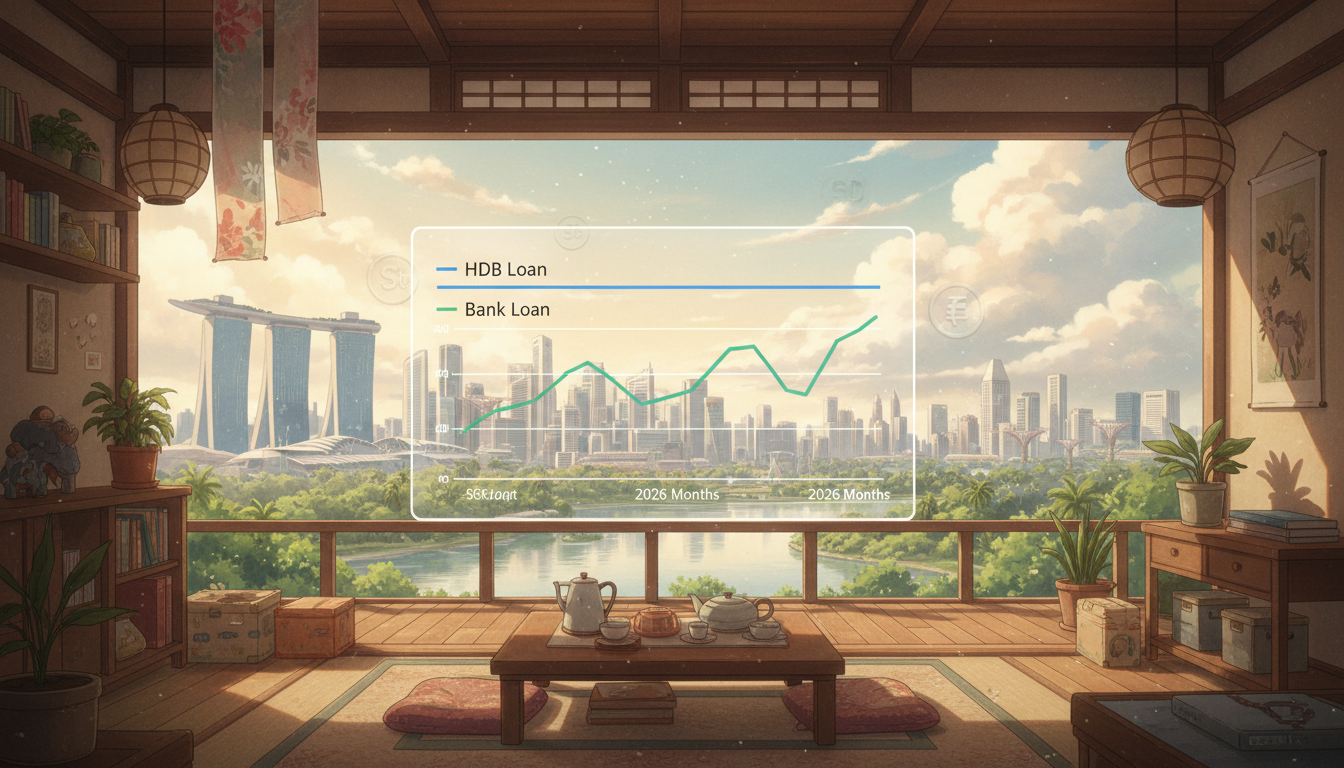
The chart below shows recent interest rate trends in Singapore:
With this context, it becomes clear why having accurate, up-to-date documentation is critical: it affects both your eligibility and the type of rate packages (fixed vs floating, SORA-pegged vs board rates) that banks are willing to extend to you.
Step-by-Step: How to Prepare Your HDB Loan Documents Safely
Based on real experiences working with buyers across estates like Yishun, Sengkang, and Bukit Batok, here is a practical preparation framework Homejourney recommends.
Step 1: Confirm Your Household Profile
- List all applicants and occupiers (spouse, children, parents, siblings where relevant).
- Check that all NRIC addresses are updated via ICA or Singpass.
- Gather identity documents: NRIC, passports (if any non-citizen members), marriage/birth certificates.[6][7]
Tip: Do this even before you start browsing flats on Property Search . Many buyers get stuck later because household composition was not planned properly from the beginning.
Step 2: Retrieve Income and CPF Documents
- Log in to myTax Portal (IRAS) with Singpass to download your latest NOA(s).[4]
- Log in to myCPF Online Services and download your latest 12 months’ CPF contribution history and CPF Property Withdrawal Statement, if applicable.[4]
- Collect your latest 3–6 months’ payslips, or 2 years’ NOA if self-employed.[4][7]
Insider timing tip: If you receive annual bonuses around February–March, your NOA might show higher income than your typical month. HDB does not automatically assume that level every month; it follows its own income assessment rules.[7] Use Homejourney’s mortgage calculator at to stress-test your loan size at more conservative income levels.
Step 3: Check Existing Property and Loan Status
- If you own any property, log into IRAS My Property Dashboard and download the property details.[4]
- If you currently own an HDB flat, retrieve your HDB Flat Details and HDB Financial Information via MyHDBPage.[4]
- Note any outstanding housing loans, both local and overseas.
This step is crucial for second-timers or HDB upgraders. It affects your eligibility for a second HDB loan, resale levy, and how much CPF you can use.[6][7]
Step 4: Apply for HFE Letter with Correct Documents
- Go to the HDB Flat Portal and start your HFE application with Singpass.[6]
- Allow MyInfo to pull your IRAS, CPF, and employment data automatically where possible.[7]
- Upload additional documents when prompted (e.g. foreign income statements, business registration, divorce documents).[5][7]
HDB’s own guidance emphasises that providing complete, accurate information and documents upfront will speed up the HFE assessment.[6][7] Once your HFE letter is approved, you are one major step closer to your HDB loan.
Step 5: Use the Same Document Set with Homejourney for Bank Loan Comparison
Even if you intend to take an HDB loan, it is prudent to compare against bank offers to ensure you are choosing the safest and most cost-effective option for your situation.[6] With Homejourney, you can:
- Upload or connect your documents once via Singpass/MyInfo.
- Compare rates from DBS, OCBC, UOB, HSBC, Standard Chartered, Maybank, CIMB, and others on Bank Rates .
- Use the eligibility calculator
References