For most HDB buyers in Singapore, you can use your CPF Ordinary Account (OA) to pay most or even all of your HDB down payment, depending on whether you take an HDB loan or a bank loan and how much OA savings you have.[1][2][6]
Understanding exactly how to use CPF for your HDB down payment is critical for safe borrowing, cash flow planning, and choosing between the best HDB loan or a bank loan. This cluster guide from Homejourney sits under our main HDB Financing Pillar, which covers HDB loan eligibility, HDB home loan rates September 2026, HDB mortgage rates, and HDB loan comparison September in detail.
CPF for HDB Down Payment: Quick Summary for First-Time Buyers
Here is a concise summary of how CPF works for HDB down payments in 2026:
- HDB loan (BTO or resale): Down payment is typically 25% of the purchase price, and this can be paid fully using CPF OA (no minimum cash component), subject to your available OA and CPF housing rules.[2][6]
- Bank loan for HDB: Down payment is also 25%, but at least 5% must be paid in cash, while the remaining 20% can be from CPF OA or cash.[2][4]
- Option/booking fees are usually paid in cash first; for HDB loans, some of this may later be refunded from CPF when HDB processes the down payment.[1][3][4]
- You may choose to retain up to $20,000 in CPF OA instead of using everything for down payment, to act as a buffer for future instalments.[2][6]
- CPF usage is subject to rules like minimum 20-year remaining lease and lease covering youngest buyer to age 95 for full usage.[3][6]
In practice, most young couples buying a 4-room BTO in estates like Punggol or Tengah use a mix of CPF for down payment and monthly instalments, keeping some cash for renovation and emergencies.
Who Can Use CPF for HDB Down Payment (and Key Eligibility Rules)
Before planning your down payment, confirm that you and your flat qualify for CPF usage:
- CPF Housing Scheme must apply to your purchase. CPF OA can be used to buy new or resale HDB flats under this scheme.[6]
- Flat lease must have at least 20 years remaining for CPF to be used at all.[3][6]
- For full CPF usage, the lease should cover the youngest buyer to age 95, otherwise CPF usage is capped.[3]
- Usage is also constrained by loan-to-value (LTV) limits and MAS income rules (MSR/TDSR).
In mature estates such as Toa Payoh or Queenstown, some older resale flats may have shorter remaining leases, so CPF usage could be limited. This is where Homejourney’s verified project and lease data via Projects Directory becomes important for safe decision-making.
HDB Loan vs Bank Loan: How CPF Down Payment Differs
Your choice between an HDB concessionary loan and a bank loan directly affects how much CPF you must or can use for your HDB down payment.
Using CPF for Down Payment with an HDB Loan
For buyers using an HDB housing loan:
- Down payment: At least 25% of the purchase price.[2][7]
- Source: This entire 25% can be fully paid with CPF OA, or a mix of CPF and cash.[2][6]
- CPF usage requirement: HDB requires you to use available CPF OA first, but you are allowed to retain up to $20,000 in OA if you choose.[2][6]
Example: A couple buying a new 4-room BTO in Tengah priced at $420,000 with an HDB loan.
- Down payment (25%): $105,000
- They have $130,000 combined in CPF OA.
- They can choose to use $105,000 from CPF OA and keep $25,000 as buffer, or use more CPF and less cash depending on their comfort level.
This flexibility makes HDB loans attractive for buyers with strong CPF balances but limited cash, especially younger households living in non-mature towns like Sembawang or Punggol.
Using CPF for Down Payment with a Bank Loan
For buyers taking a bank loan from DBS, OCBC, UOB, or other banks through Homejourney:
- Total down payment: 25% of the purchase price.[2][4]
- Cash minimum: At least 5% must be cash, not CPF.[2][4]
- CPF component: Up to 20% can be from CPF OA or extra cash.[2][4]
Example: A buyer taking a bank loan for a 5-room resale flat in Jurong West priced at $600,000.
- Total down payment (25%): $150,000
- Minimum cash (5%): $30,000
- Remaining 20% ($120,000) can be CPF OA or cash.
Many upgraders who have built up CPF OA from years of working in the CBD or Changi Business Park choose bank loans for potentially lower HDB mortgage rates compared to the concessionary 2.6% HDB rate, especially when fixed or SORA-pegged packages look attractive. To compare current HDB home loan rates September 2026 and HDB loan comparison September, use Homejourney’s live bank rates page at Bank Rates .
Step-by-Step: How to Use CPF for Your HDB Down Payment
This section walks through the end-to-end process from flat selection to key collection, focusing specifically on CPF usage touchpoints.
Step 1: Estimate Budget and CPF Usage Safely
- Check your CPF OA balance using the CPF mobile app or website. Take note of your OA amount and your partner’s OA if buying jointly.
- Estimate property price range using Homejourney’s affordability and mortgage calculator at Mortgage Rates or . Consider how much CPF you want to keep as a safety buffer.
- Decide whether you are leaning towards HDB loan (more CPF flexibility, stable 2.6% interest) or bank loan (potentially lower rates, but mandatory cash 5% down payment). For a deeper comparison, refer to HDB Loan vs Bank Loan 2026: Safe Borrowing Guide by Homejourney .
Local tip: Many buyers in newer towns like Punggol and Sengkang prefer to preserve some CPF for future instalments and renovations, because new flats often require more renovation spending than older “move-in” resale units in estates like Ang Mo Kio.
Step 2: Apply for HLE (HDB Loan) or Bank In-Principle Approval
Before your down payment is due, secure proof of how much you can borrow:
- HDB loan: Apply for an HDB Loan Eligibility (HLE) letter directly with HDB. This letter is usually required before you book a BTO or exercise a resale option.
- Bank loan: Get an In-Principle Approval (IPA) from banks. Instead of applying bank by bank, use Homejourney’s multi-bank application at Bank Rates . One Singpass-powered form submits to DBS, OCBC, UOB, HSBC, Standard Chartered, Maybank, CIMB, RHB, and others.
Because Homejourney integrates with Singpass/MyInfo, your income, employment, and CPF data are auto-filled, greatly reducing errors and speeding up eligibility checks. This is especially useful if your CPF contributions vary due to bonuses or commission-based jobs in areas like Raffles Place or One-North.
Step 3: Pay Option / Booking Fees (Usually Cash First)
When you secure a flat, you usually pay a booking or option fee:
- BTO: Pay a booking fee (often $500 to $2,000 depending on flat type) when selecting a unit. This is typically paid in cash or NETS.
- Resale: Pay an Option Fee (commonly up to $1,000) to the seller to secure the Option to Purchase (OTP).[1]
According to CPF rules, option and booking fees must typically be paid in cash upfront.[1][4] If you take an HDB loan, part of this may be effectively refunded to you from CPF when the down payment is processed at the Agreement for Lease stage.[3]
Step 4: Indicate CPF Usage When Signing Agreement for Lease / Completion Papers
The real CPF action happens when you sign the legal documents:
- For new BTO flats, you sign the Agreement for Lease, and this is when the main down payment is due.[5]
- For resale flats, CPF is used at completion to pay the seller via HDB or the law firm.
At this stage:
- You and your lawyer/HDB officer will fill in the CPF withdrawal instructions, indicating how much OA to use for down payment, legal fees, and stamp duty.[6]
- If you are using an HDB loan, you can also request to retain up to $20,000 in OA for future instalments.[2][6]
- CPF Board and HDB coordinate directly; you do not need to manually transfer money from CPF to HDB.
Insider note: At HDB Hub in Toa Payoh, the process is very structured — you typically have a specific appointment time, and the HDB officer will walk through all the figures (loan amount, CPF usage, cash top-ups) before you sign. Bring your Singpass login in case any digital verification is needed.
Step 5: CPF for Remaining Down Payment, Stamp Duty, and Fees
Beyond the basic down payment percentage, CPF OA can also cover:
- Buyer’s Stamp Duty on the property purchase price;
- Additional Buyer’s Stamp Duty (if applicable);
- Legal and conveyancing fees; and
- Home Protection Scheme (HPS) premiums for HDB loans.[3][4][6]
Many buyers initially pay stamp duty and legal fees in cash (via PayNow/NETS), then request reimbursement from CPF once the legal documents are processed. Confirm this timeline with your HDB officer or lawyer so you know when cash will be reimbursed.
How CPF Usage Interacts with HDB Home Loan Rates and Bank Packages
When deciding how much CPF to commit to your down payment, you should also consider current HDB home loan rates September 2026 and prevailing bank HDB mortgage rates.
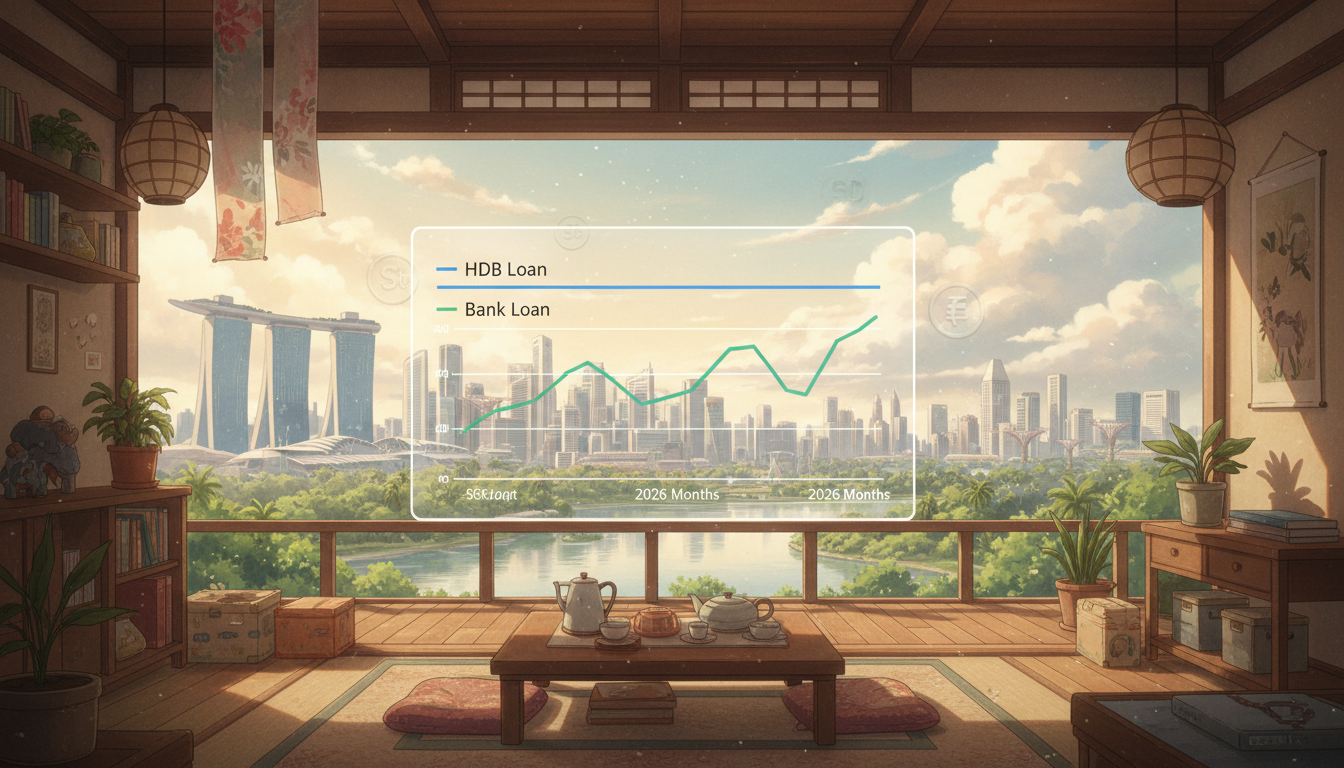
HDB’s concessionary rate is pegged at 0.1% above the prevailing CPF OA interest rate and is currently 2.6% p.a..[2] Bank loan rates, especially SORA-pegged packages from DBS, OCBC, UOB, HSBC, Standard Chartered, Maybank, CIMB, and others, may be higher or lower at different points in the rate cycle, often with lock-in periods.
The chart below shows recent interest rate trends in Singapore:
Using this kind of rate trend view (which Homejourney provides for 3M and 6M SORA on Bank Rates ) helps you decide whether to:
- Use more CPF to reduce loan size when rates are high;
- Keep more CPF invested and take a slightly larger loan when rates are relatively low; or
- Plan for future refinancing once rates move in your favour.
For deeper analysis of HDB loan interest rate movements, refer to HDB Loan Interest Rate Trends 2026: Homejourney Analysis and Business Times Property for broader market coverage.
Documentation Checklist to Use CPF for HDB Down Payment
To ensure your CPF is available and correctly applied to your down payment, prepare these key documents early:
- NRIC of all buyers and occupiers;
- CPF statements (OA balances and transaction history) – can be downloaded from the CPF website;
- Income documents: latest 3 months’ payslips or IRAS Notice of Assessment; for self-employed, income tax and business documents;
- HLE letter (for HDB loan) or bank IPA (for bank loan);
- Option to Purchase (resale) or HDB flat booking documents (BTO);
- Any existing CPF housing usage statements if you already used CPF for another property.
For a more comprehensive document list, see Documents Needed for HDB Loan: 2026 Safe Buyer Checklist | Homejourney and HDB Loan Documents Checklist 2026: Homejourney Guide .
Common Pitfalls When Using CPF for HDB Down Payment (and How to Avoid Them)
Based on real cases we see among buyers from towns like Woodlands, Yishun, and Bukit Panjang, here are frequent mistakes:
- Using 100% of CPF OA for down payment and having no buffer for monthly instalments if one partner loses a job or takes unpaid leave. Consider keeping at least a few months of instalments in CPF or cash.
- Ignoring lease/age CPF limits when buying older resale flats in mature estates. Always check CPF usage caps for flats with shorter remaining leases.[3][6]
- Underestimating cash needs
References
- Singapore Property Market Analysis 1 (2026)
- Singapore Property Market Analysis 2 (2026)
- Singapore Property Market Analysis 6 (2026)
- Singapore Property Market Analysis 4 (2026)
- Singapore Property Market Analysis 3 (2026)
- Singapore Property Market Analysis 7 (2026)
- Singapore Property Market Analysis 5 (2026)